Technology

Generative AI vs Agentic AI: What’s the Difference and Which One Does Your Business Need?

Generative AI vs Agentic AI: What’s the Difference and Which One Does Your Business Need?

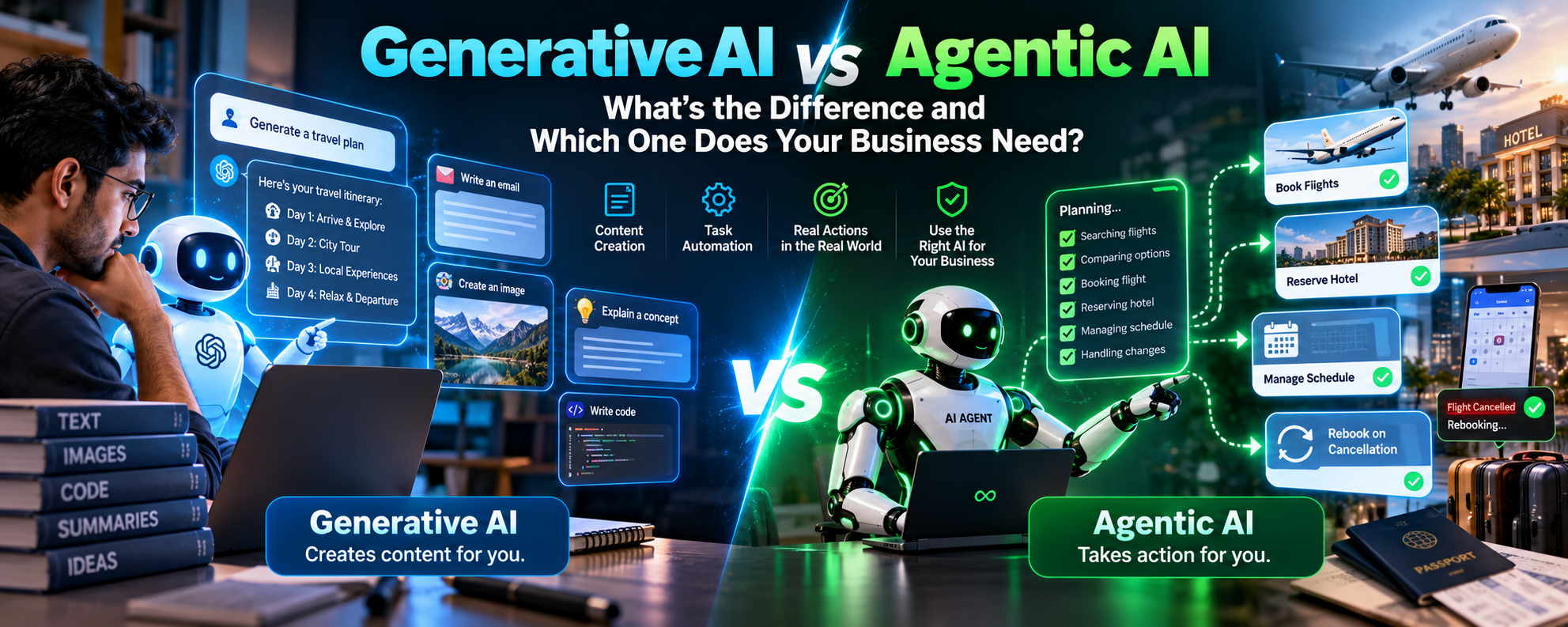
Ask a generative AI tool to plan your trip and it hands you a nice itinerary. Ask an agentic AI to plan your trip and it books the flights, reserves the hotel, and rebooks you when your connection gets cancelled. Same underlying technology family, very different jobs. Here’s a clear breakdown of how they differ, the real products on each side (from ChatGPT and Claude to Meta’s new Muse agent), and how to decide which one a task actually calls for.

The one-line difference

Generative AI produces content for a human to act on, while agentic AI acts itself. That single distinction explains almost everything else.

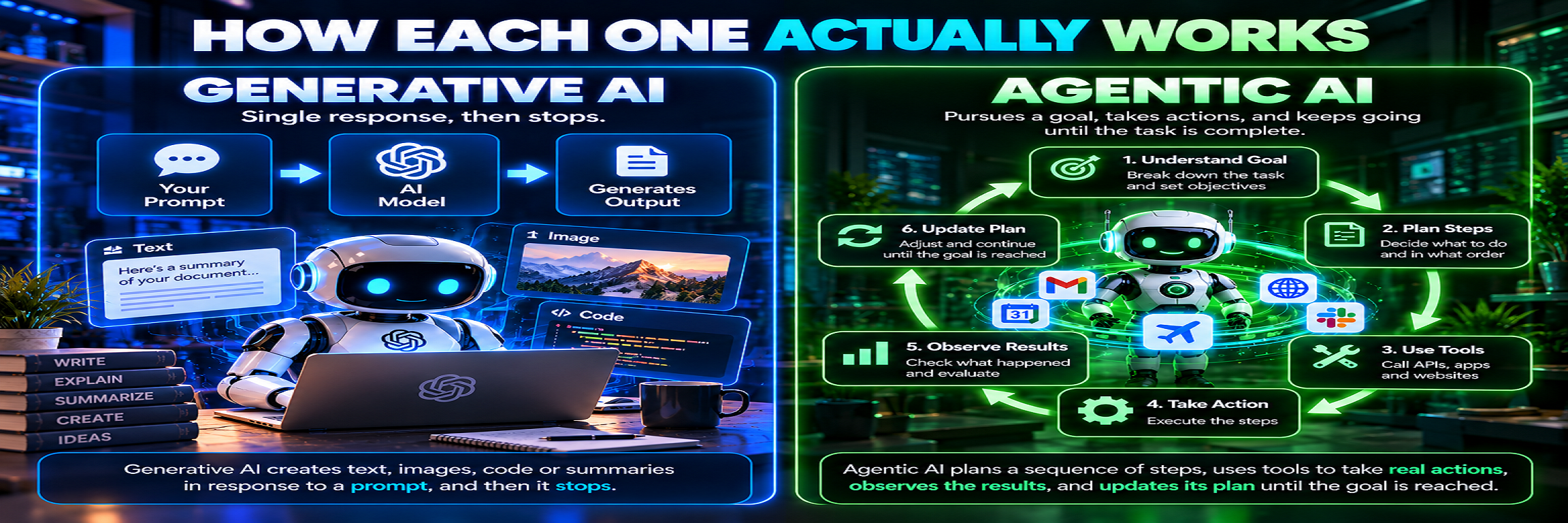
Generative AI creates text, images, code, or summaries in response to a prompt, and then it stops. Agentic AI pursues a goal: it plans a sequence of steps, uses tools to take real actions, observes the results, and updates its plan until the goal is reached. One framing that sticks: generative AI changes what your software produces, while agentic AI changes what your software does.
How each one actually works

Generative AI is typically a single inference call. You write a prompt, the model returns an output, and the interaction ends. It is reactive and generally stateless, so it doesn’t follow up unless you prompt it again.

Agentic AI wraps a generative model in a loop. It perceives the current state, decides what to do, calls tools, and updates its plan based on what happened. The fundamental architectural difference is that agent loop, backed by orchestration, memory, and tool access.

Real products: who’s on which side

Generative AI examples. The best-known generative tools are ChatGPT, Claude, Gemini, and Midjourney. You give them a prompt, and they return writing, analysis, code, or images for you to review and use. Typical jobs include drafting emails, summarizing documents, brainstorming, explaining concepts, and generating visuals.

Agentic AI examples. On the agent side, the commonly cited names include AutoGPT, Devin, and Claude Code in its agentic mode. The newest and most visible consumer example is Muse, from Meta:

  • Muse is a personal AI agent announced by Meta on 8 September 2026, designed to carry out long-running tasks on a user’s behalf rather than answering in a single exchange like a chatbot. It launched in the United States on iOS, Android and the web.
  • It can book travel, manage email, and complete multi-step tasks across the web. It is powered by Muse Spark, Meta’s model built for real-world agentic work.
  • Each agent runs on a virtual machine hosted in Meta’s cloud and is used through a chat interface. At checkout it can pay using Link built by Stripe.
  • Adoption has been fast. Muse reached 2.5 million downloads within two weeks, a sign that agentic AI is moving from a developer curiosity toward mainstream consumer behavior.

Muse also shows the friction agents run into. Amazon blocked Muse to protect its data advantages and customer relationships, while Shopify welcomed it. And it’s a reminder to check the fine print on “automation”: 404 Media reported that some phone calls Muse placed to businesses, presented as automated, were being completed by human call-center workers during beta testing.

Feature Generative AI Agentic AI
Core purpose Creates content from prompts Pursues goals and completes tasks
Behavior Reactive, one prompt, one response Proactive within its assigned goal
Memory Typically stateless Persistent memory across steps
Tool use Limited or none Calls APIs, apps, and websites
Human involvement Directs every step Sets the goal, AI executes
Example products ChatGPT, Claude, Gemini, Midjourney Muse (Meta), Devin, AutoGPT, Claude Code (agentic mode)
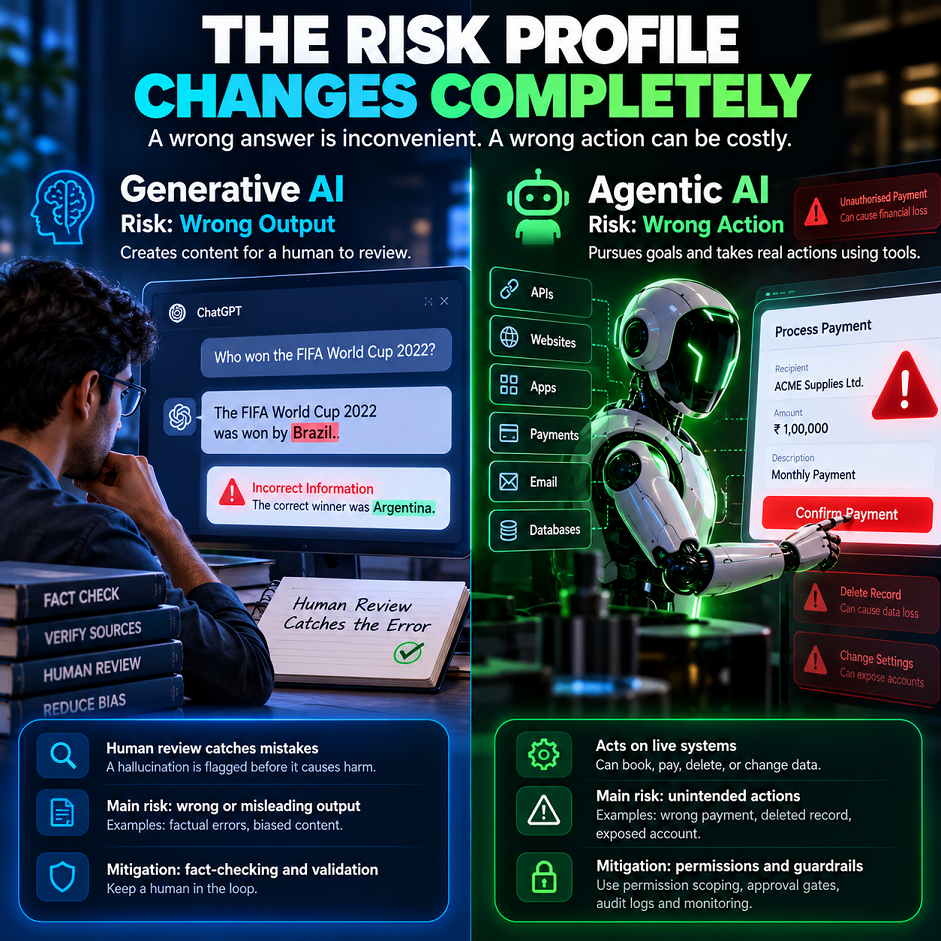
Primary risk Informational: hallucinations and bias Operational: unintended actions on live systems
Infrastructure Single inference per request Repeated inference loops plus orchestration

Same task, two approaches

  • Customer service: Generative AI drafts a reply explaining a delayed shipment, and a human reviews and sends it. Agentic AI looks up the order, issues the refund or reroute, and updates the customer within set rules.
  • Software development: Generative AI writes a code snippet from a prompt. Agentic AI runs tests, finds failures, patches the code, and deploys within predefined limits.
  • Travel and shopping: A generative chatbot suggests flights and products. An agent like Muse can research, book, and check out on your behalf.

They’re not rivals, they’re layers

The most common mistake is treating this as an either/or choice. Most agentic systems rely on generative models for reasoning and communication, and the agentic layer adds decision-making, memory, and tool execution on top. The line is also blurring: most enterprise AI systems today combine both, and generative platforms keep adding agent-like capabilities.

The risk profile changes completely

A hallucination from a generative tool lands in front of a human reviewer who can catch it. An agent acting on live systems has no such natural checkpoint, so a mistake can be a wrong payment, a deleted record, or an exposed account. That’s why Muse has drawn scrutiny: it needs access to a user’s accounts and services to work, and safety experts have warned of serious dangers to users. Governance has to be built separately for each: output-quality checks for generative AI, and permission scoping, logging, and approval gates for agentic AI.

Which one should you use?

Reach for generative AI when the work is creating or assisting: drafting content, summarizing documents, brainstorming, writing code snippets, generating images. It’s easier to set up and cheaper to run, and a human stays in control of every output.

Reach for agentic AI when the work is a multi-step process across systems: booking, monitoring, processing requests end to end, running recurring reports. It needs a more advanced setup, but it runs on its own and removes manual hand-offs.

A practical rollout order many teams follow is generative first to build the foundation and confidence, then agentic to automate execution at scale, starting with narrow, rule-governed workflows where mistakes are easy to catch.

Key takeaways

  • Generative AI creates content in response to a prompt and stops; agentic AI pursues a goal across multiple steps and acts on its own
  • ChatGPT, Claude, Gemini, and Midjourney are the best-known generative tools; Muse (Meta), Devin, AutoGPT, and Claude Code in agentic mode represent the agent side
  • Agentic AI usually runs on top of a generative model, so it builds on generative AI rather than replacing it
  • Risk shifts from wrong output to wrong action, so oversight and permissions matter far more for agents
  • Use generative AI for content and assistance, agentic AI for workflow automation, and expect most real systems to combine both