Jev is an AI model from TypeSafe AI, a San Francisco lab that came out of two years of stealth development on September 15, 2026, with Jev as its first public release. It was built by Diogo Almeida, who worked on the training methods behind ChatGPT and InstructGPT while at OpenAI, alongside co-founders Erik Gafni and Sasha Sheng.
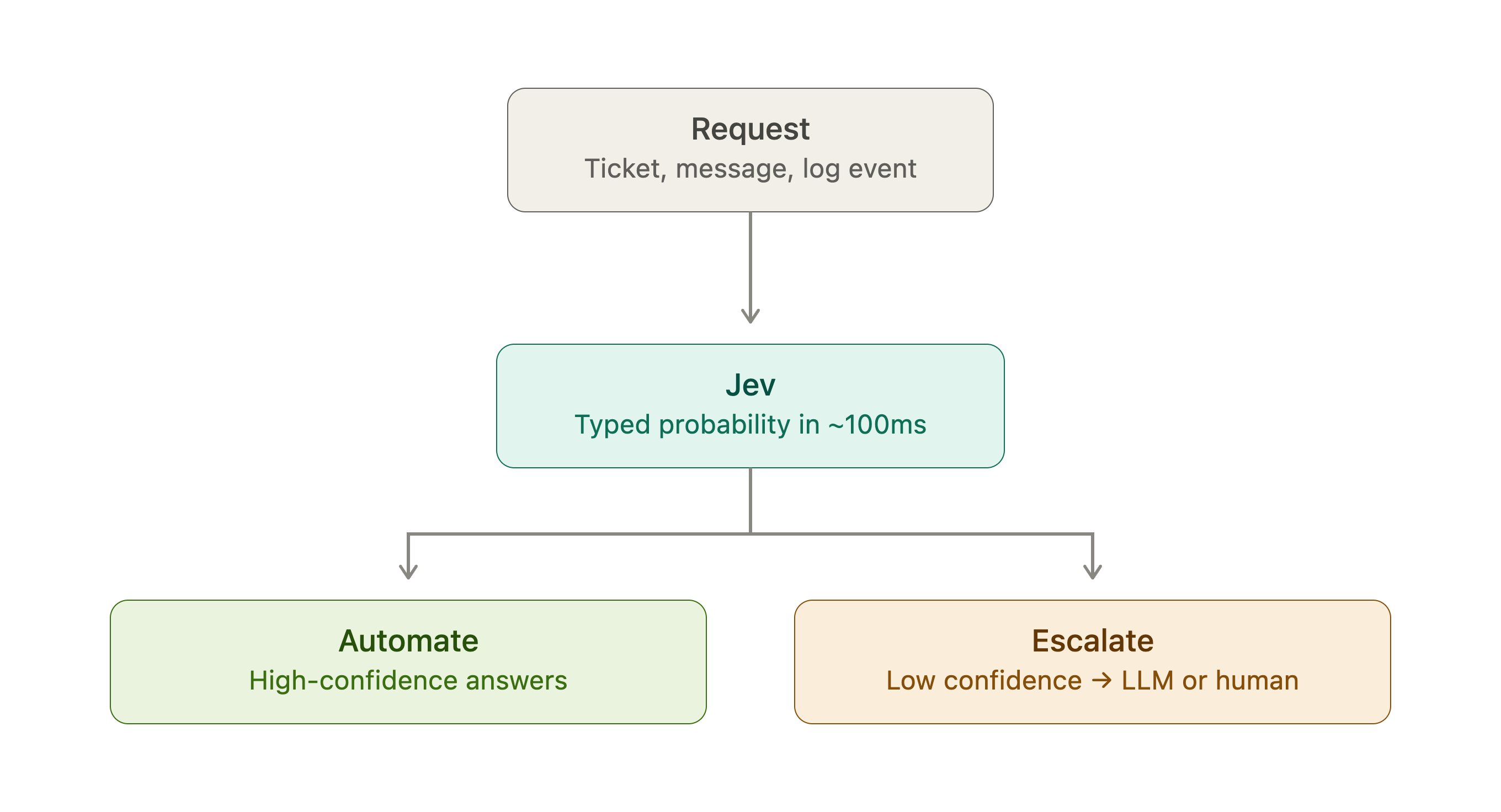
TypeSafe describes Jev as the first "System One" model — a new category of AI that doesn't generate text at all. Instead of writing a reply, it takes a block of state (your data) and returns typed, probabilistic decisions in a single parallel pass, more like a frontier-intelligence function call than a chatbot.
Here's the simplest way to think about it: Jev is a really smart if statement. Ordinary code can branch on things it can calculate — if order.total > 100. It falls apart the moment the condition requires judgment: Is this email a complaint? Does this resume actually show AI experience? Should this transaction be flagged as risky? Jev is built to answer exactly those kinds of questions, instantly and cheaply, so your code can branch on the answer.
Where the names come from, if you're curious: "System One" is a nod to Daniel Kahneman's Thinking, Fast and Slow, which describes two modes of thought — fast, intuitive System 1 judgments, and slow, deliberate System 2 reasoning. TypeSafe borrowed the System 1 half for a model built to make quick judgments inside software. And "Jev" comes from the 19th-century economist William Stanley Jevons, whose paradox observed that when steam engines got more efficient, coal use went up, not down, because cheaper power meant people found more uses for it. TypeSafe is betting the same thing happens with AI: make decisions cheap enough, and people will use AI in far more places than they do today.