Technology

Physical AI Explained: How Intelligent Robots Are Learning to Operate in the Real World

Physical AI Explained: How Intelligent Robots Are Learning to Operate in the Real World

For decades, robots were fast, strong, and strictly obedient. They welded the same seam ten thousand times, but move the part a few centimeters and they failed. Physical AI is changing that. By combining the foundation-model technology behind modern chatbots with cameras, sensors, and simulation, robots are starting to perceive, reason, and adapt in messy real-world environments. Here’s what physical AI is, how robots actually learn, who’s building it, and how much of the hype is real.

The problem: robots were never good at surprises

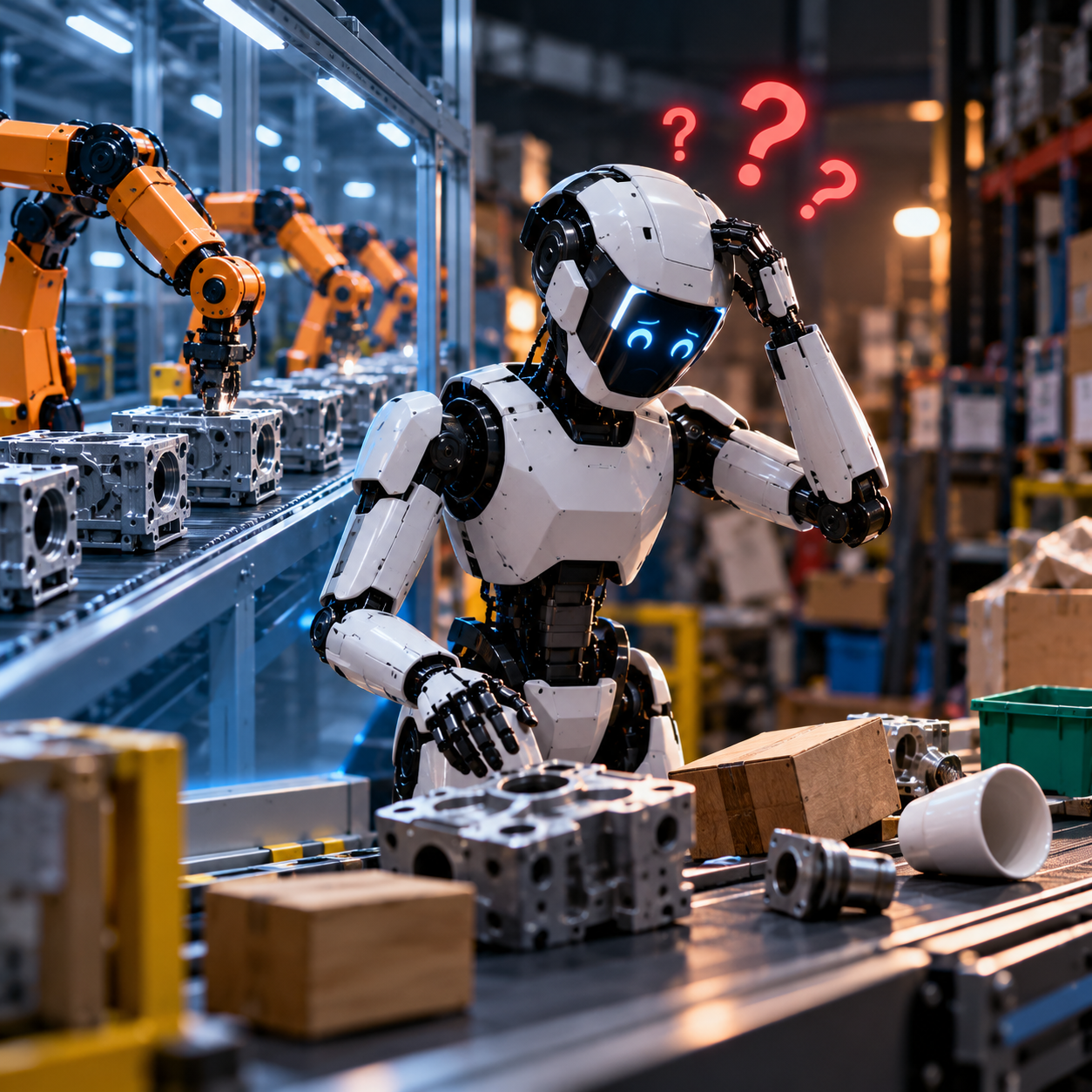
Traditional industrial robots are programmed with exact instructions, and they excel when the world cooperates: the part is always in the same place, the lighting never changes, the task never varies. That’s why they thrive in tightly controlled car factories and struggle almost everywhere else. A warehouse, a hospital, a kitchen, or a street is unpredictable, and hand-coding a rule for every possible situation is impossible.

Physical AI is the attempt to fix that, not by writing more rules, but by letting machines learn.

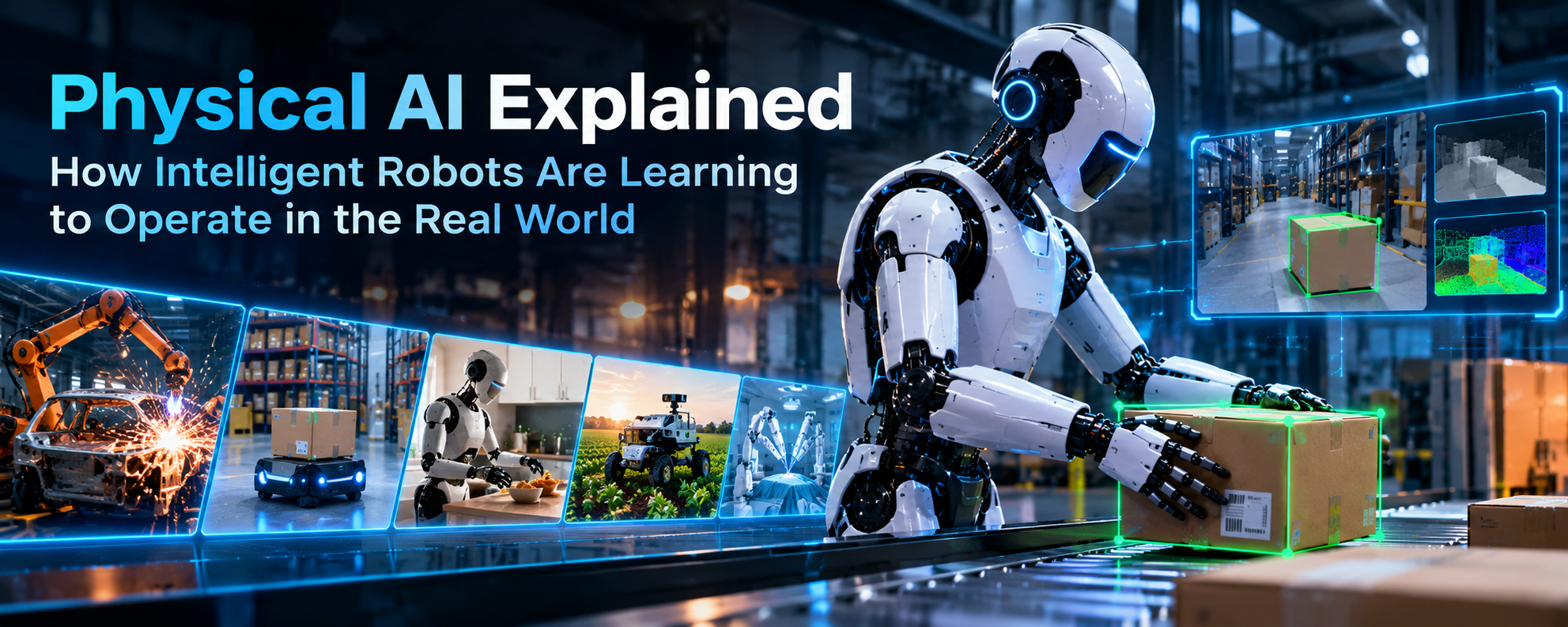
Physical AI refers to artificial intelligence systems that enable machines to autonomously perceive, understand, reason about, and interact with the physical world in real time. The key contrast with older robotics: whereas traditional robots follow set instructions, physical AI systems perceive their environment, learn from experience, and adapt their behavior based on real-time data and changing conditions.

The term gained mainstream traction when NVIDIA CEO Jensen Huang declared at CES 2026 that “the ChatGPT moment for robotics has arrived.” The underlying idea: the same foundation model architecture that made large language models possible is being adapted for robots that learn from experience rather than following pre-programmed scripts.

Physical AI covers more than humanoids. Common examples include self-driving cars, warehouse robots such as Amazon’s Proteus, surgical robots, autonomous tractors, and humanoid robots.

How robots actually learn

Three ingredients make physical AI work.

1. Robot foundation models (vision-language-action models). A VLA model takes in what the robot sees plus an instruction in plain language, and outputs the physical actions to take. Physical AI adopts training methods from large language models while incorporating data that describes the physical world. Foundation models trained on massive cross-embodiment datasets are now enabling robots to generalize across tasks, objects, and environments in ways that were research fantasies three years ago. Names in this space include Pi0, OpenVLA, and NVIDIA’s GR00T, and Figure AI’s Helix is described as the first VLA designed specifically for humanoid robots.

2. Simulation and world models. Learning by trial and error on a real robot is slow, expensive, and risky. So developers train in simulation first. World foundation models learn how the physical world behaves, so robots can be trained and tested in simulation before they touch reality. Combined with world models like NVIDIA Cosmos that simulate physics, robots can train on billions of synthetic scenarios before touching a real object.

3. Real-world data to close the gap. Simulation never perfectly matches reality, a problem known as the sim-to-real gap. The fix is to fine-tune on real robot data. For example, GR00T N1 was pre-trained on over a million simulated humanoid episodes, then fine-tuned with 50K to 100K real episodes. The same source argues a 4 to 10x reduction in data requirements is the primary economic argument for foundation models.

Finally, learning continues after deployment: real-world data fed back into training policies and simulation spaces helps robots keep improving.
Who’s building it

The ecosystem has two layers. At the foundation are the world model and robotics-brain builders; on top are the applied companies building humanoids, vehicles, and factory systems.

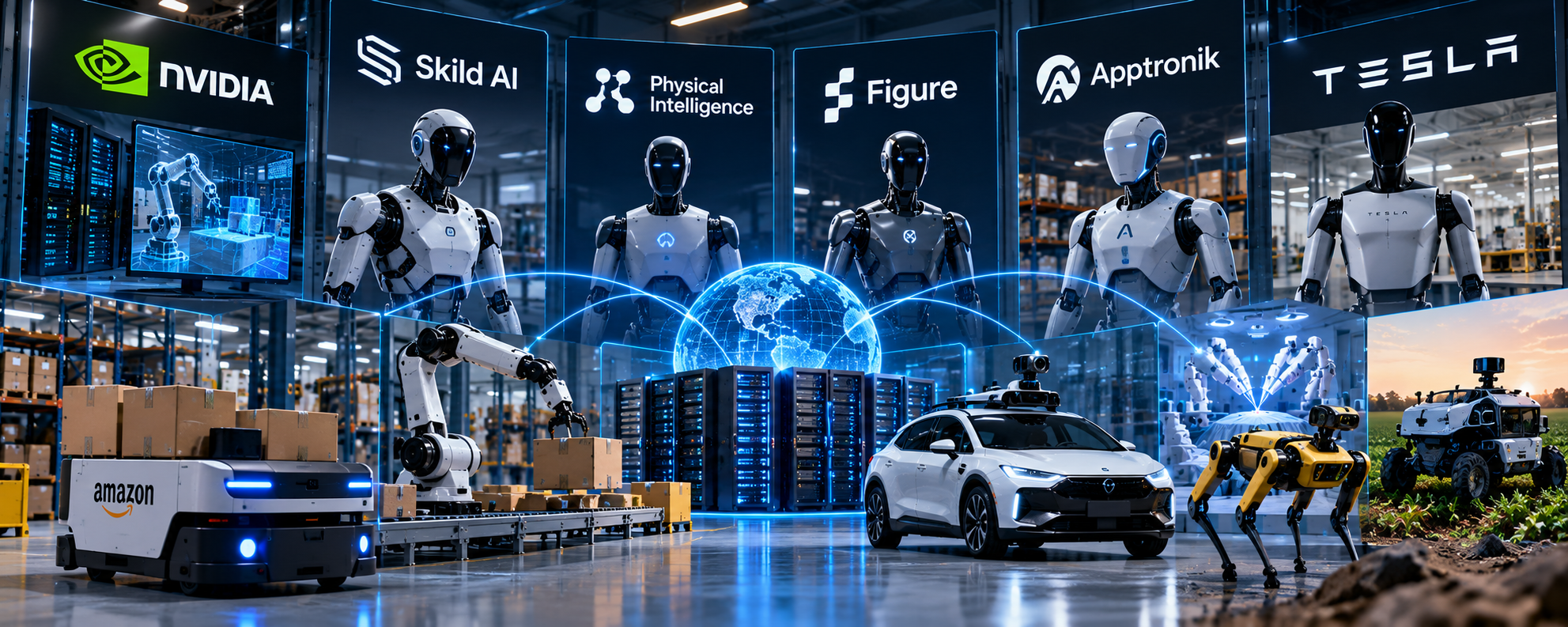
  • Robot brains: Skild AI raised $1.4 billion to build foundation models for robots, the largest single round in the Q1 2026 physical AI funding wave. Physical Intelligence is pursuing a single model that can control many different robots across many tasks
  • Humanoids: Apptronik secured $520 million for humanoid robots aimed at industrial labor, and Tesla is building its Optimus humanoid. Figure develops general-purpose humanoids for warehouses and manufacturing.
  • Platforms: NVIDIA announced Cosmos 3, described as the first world foundation model unifying synthetic world generation, vision reasoning, and action simulation, with humanoid makers like Boston Dynamics, Figure, Agility, and 1X building on its tools

Where it’s being used

Today’s real deployments are mostly practical and narrow: warehouse picking and carrying, factory material handling, inspection, autonomous vehicles, surgical assistance, and agriculture. At ICRA 2026, the REAL-I challenge tested robot policies on tasks such as metal parts righting, daily chemical bottle pick-and-place, and express package scanning. Notice how ordinary those tasks are. The near-term value of physical AI is less about robot butlers and more about reliable work in logistics and manufacturing.

The reality check

  • Demos aren’t deployment. A robot that performs a task once in a controlled video is very different from one that works reliably for a full shift. Even research challenges stress the importance of testing whether the complete pipeline supports stable deployment on physical robots
  • Narrow adaptation. Deloitte’s analysis notes that in research, robots do adapt after moving from simulation to physical environments, but they learn around tasks, not holistic environmental interactions.
  • Real-world data is scarce. Unlike text, there’s no internet-sized archive of robot experience, which is why simulation and data collection are such big investments.
  • Safety and cost. Machines acting near people carry physical risk, and humanoids are still expensive. One consumer humanoid opened pre-orders at $20,000, which hints at where pricing is heading but also how early the market is.
  • The hype premium. Funding rounds in the hundreds of millions to billions signal strong investor belief, not proven returns.

Key takeaways

  • Physical AI is AI that perceives, reasons, and acts in the real world, learning from experience instead of following fixed scripts
  • Robots learn through vision-language-action foundation models, large-scale simulation with world models, and fine-tuning on real data
  • Money and talent are flooding in: Skild AI’s $1.4B round and Apptronik’s $520M are among 2026’s biggest
  • Real deployments today are mostly warehouse, factory, and vehicle tasks, not general-purpose home robots
  • The hard problems remain: the sim-to-real gap, scarce real-world data, safety, and cost

Frequently Asked Questions

What’s the difference between physical AI and traditional robotics?

Traditional robots follow pre-programmed instructions and work best in controlled, repetitive settings. Physical AI systems perceive their surroundings, learn from experience, and adapt to changing conditions, so they can handle variation that would stop a scripted robot.

Is physical AI the same as embodied AI?

The terms overlap and are often used interchangeably. Broadly, physical AI uses sensors, actuators, and AI models to act in the real world, while embodied AI often emphasizes machines that develop skills through practice, like a humanoid learning to walk. They increasingly work together.

How do robots learn without breaking things?

Mostly by practicing in simulation. Developers train robots on huge numbers of virtual scenarios using world models and physics simulators, then fine-tune on a smaller amount of real-world data to close the gap between simulation and reality.

When will humanoid robots be common in homes and workplaces?

Workplaces first, and in limited roles. Warehouses and factories are the near-term focus because the tasks are structured and the economics are clearer. Home robots remain early and costly, so expect gradual progress rather than a sudden switch.