Technology

Reverse Engineering: How Developers and Security Teams Figure Out How Software Works Without the Source Code

Reverse Engineering: How Developers and Security Teams Figure Out How Software Works Without the Source Code

Every day, someone needs to understand a piece of software they can’t read: a suspicious file that just hit the network, a decades-old program nobody has the source code for, a device that refuses to talk to anything else. Reverse engineering is how they get answers. It sounds like a hacker trick, but it’s a standard professional discipline, and in 2026 AI is changing how fast it’s done. Here’s what it is, why it matters, and where the lines are.

The problem: you can’t always read what you depend on

Most software is shipped as compiled binaries, not readable source code. That’s fine until something goes wrong. A company’s critical system runs on a program written 15 years ago by a vendor that no longer exists. A security team receives a file that might be malware. Two products need to work together but one has no documentation. In each case, the people responsible need to know what the software actually does, and the source code isn’t available.

Reverse engineering closes that gap. It’s the process of taking a finished product apart to understand its design, behavior, and logic, working backward from the result instead of forward from a spec.

So what exactly is reverse engineering?

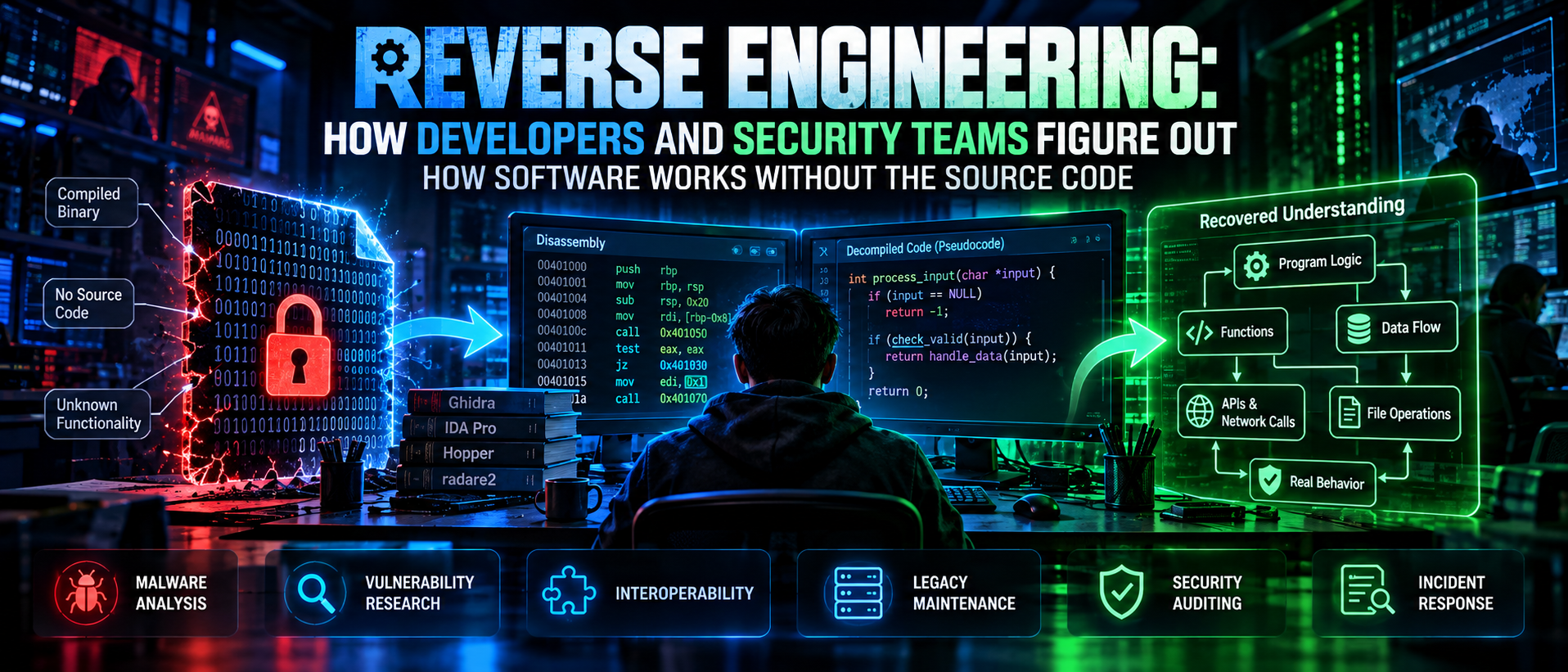
At its core, it’s analysis in reverse. A normal development flow goes from idea, to design, to code, to a finished product. Reverse engineering starts at the finished product and rebuilds an understanding of the design behind it.

It shows up in several forms:

  • Software reverse engineering: analyzing compiled programs to understand their logic, often through assembly code or decompiled pseudocode
  • Protocol and file-format analysis: working out how two systems talk to each other or how an undocumented file is structured
  • Firmware and hardware analysis: examining the code and design inside devices like routers, cameras, or industrial controllers
  • Mobile and application analysis: inspecting apps to understand behavior, data handling, and permissions

Where it’s used for good

Reverse engineering is mostly a defensive and practical discipline:

  • Malware analysis: security teams dissect suspicious files to learn what they do, how they spread, and how to detect and stop them
  • Vulnerability research: researchers find security flaws in software and report them so they can be fixed before attackers exploit them
  • Interoperability: engineers figure out how an undocumented system works so a new product can work with it
  • Legacy maintenance: teams recover understanding of old systems whose source code or documentation was lost
  • Security auditing: companies verify that the software and devices they rely on do what they claim, with nothing hidden
  • Incident response: after a breach, analysts reconstruct exactly what an attacker’s tools did

How it works, at a high level

Analysts generally combine two approaches:

  1. Static analysis: examining the program while it sits inactive, reading its structure, strings, imports, and decompiled code to understand what it’s built to do
  2. Dynamic analysis: running the program in a controlled, isolated environment and watching its behavior: what files it touches, what network connections it makes, how it responds to input

A typical investigation starts with a quick triage of what the file is and what it seems to do, then moves into deeper analysis of the interesting parts, and ends with documenting findings. Experienced analysts do this inside isolated lab environments, never on a machine they care about.

The tools of the trade

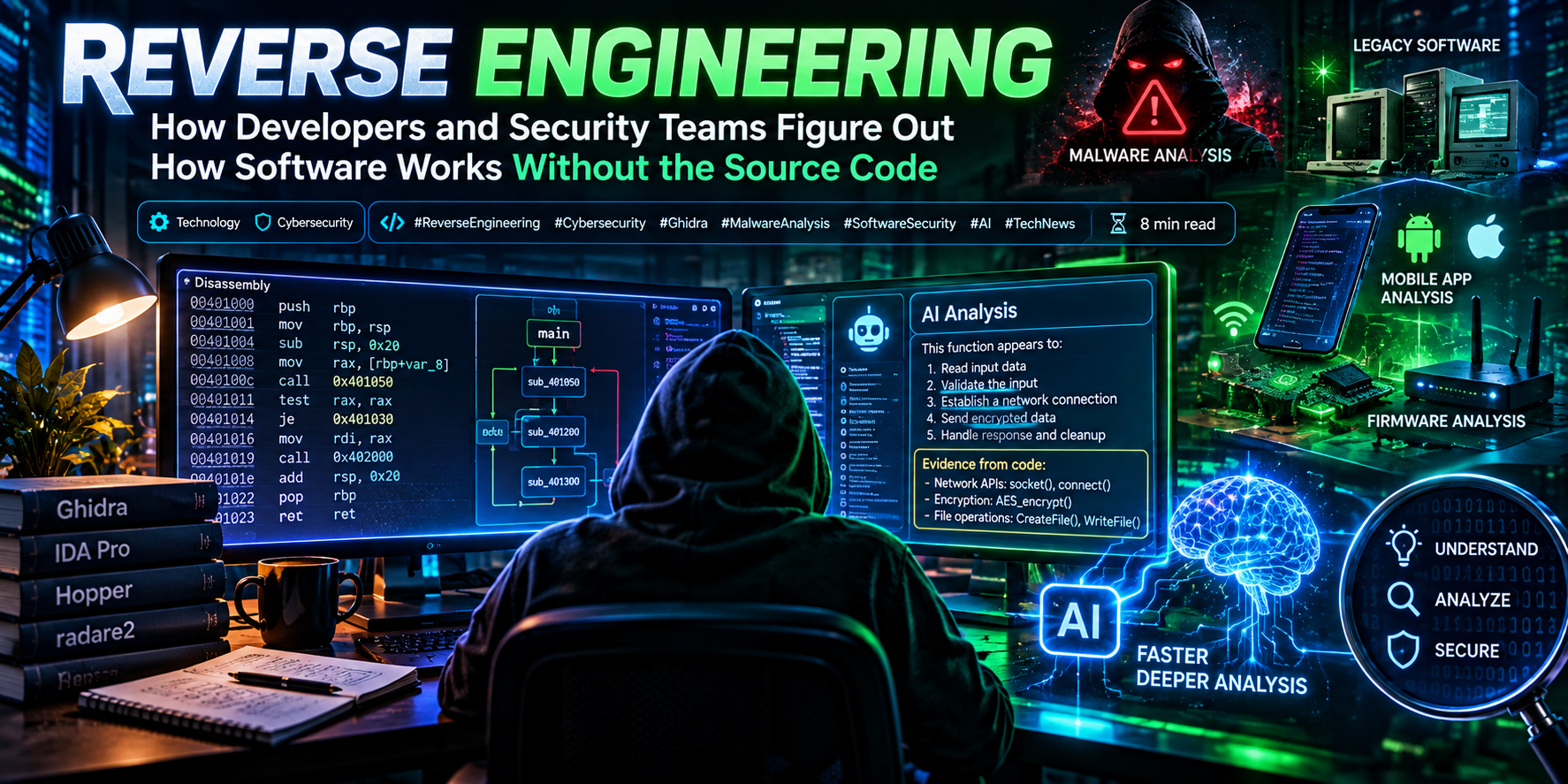
The best-known name is Ghidra, a free reverse engineering suite originally developed by the NSA. Its original author is the National Security Agency, and many security researchers consider it a viable open source alternative to the proprietary tools in this space. The commercial side is led by IDA Pro, with Hopper and radare2 also widely used. Beyond these, analysts use debuggers, packet analyzers, and mobile-specific toolkits for app analysis.

The big 2026 shift: AI joins the workflow

Reverse engineering has always been slow and highly specialized, because it produces dense, low-level output that takes real expertise to read. AI is now compressing that effort.

A growing ecosystem of plugins like GhidrAssist, GhidrOllama, and ReVa connects Ghidra to language models, so an analyst can highlight a function and simply ask what it does. The newest step is agent-driven analysis. REA, short for Reverse Engineer Anything, is an open-source project that connects AI coding agents to Ghidra, Hopper, and IDA through the Model Context Protocol (MCP), letting agents inspect software, trace relevant code, and request more evidence. Notably, it supplements the established disassemblers rather than replacing them.

The speed gains are real, but so is the main weakness: AI can be confidently wrong. One 2026 study on real malware found AI-assisted analysis matched or beat manual analysis on quality, yet the same study documented the AI inventing a botnet command that didn’t exist in the binary. And AI-generated code meant to improve readability can introduce bugs that were never in the original, which undermines correctness if it isn’t carefully validated. That’s why the better tools force claims to point at inspectable evidence, and why a human analyst still has to verify the result.

It also cuts both ways. AI-powered tools are lowering the skill barrier for analyzing compiled code across the field, which helps defenders but also means software makers can no longer count on complexity alone to protect their code.

Is it legal? The honest answer is “it depends”

This is the question everyone asks, and there’s no single global answer. The rules vary by country and context, and they usually turn on a few factors:

  • Purpose: interoperability, security research, and personal study are treated very differently from copying or piracy
  • Licenses and contracts: many software license agreements prohibit reverse engineering, and those terms can matter even where the law allows it
  • Anti-circumvention laws: rules like the US DMCA restrict bypassing protection measures, with specific exemptions for things like good-faith security research
  • What you do with the result: understanding how software works is generally treated differently from redistributing someone else’s code

Anyone doing this professionally should check the rules in their jurisdiction and the relevant license terms, and get proper authorization when analyzing software they don’t own. This is general information, not legal advice.

Protecting your own software

If you build software, assume someone will eventually analyze it. Sensible steps include not hiding secrets in the client (API keys and credentials don’t belong in shipped code), using code obfuscation and integrity checks to raise the effort required, keeping sensitive logic on the server, and designing on the assumption that the binary can be read. Obfuscation slows analysis down; it doesn’t stop it, so real security has to come from sound design.

Key takeaways

  • Reverse engineering is the practice of working backward from a finished product to understand how it works, usually without the source code
  • It’s mainly a defensive discipline: malware analysis, vulnerability research, interoperability, legacy maintenance, and security auditing
  • Analysts combine static analysis (inspecting the program at rest) with dynamic analysis (watching it run in a safe, isolated environment)
  • Ghidra, IDA Pro, Hopper, and radare2 are the core tools, and in 2026 AI plugins and agents like REA are speeding up the work
  • AI analysis is fast but can state things that aren’t true, so human verification is still essential
  • Legality depends on purpose, license terms, and local law, so check before analyzing software you don’t own
  • If you ship software, design as though it will be analyzed, and never rely on obscurity alone