Development

Why Can’t One Server Handle IRCTC? The Engineering Behind India’s Daily Ticket Stampede

Why Can’t One Server Handle IRCTC? The Engineering Behind India’s Daily Ticket Stampede

At 10 AM, millions of people tap “Book Now” within the same few seconds, all chasing a few dozen seats. If you have ever watched the IRCTC page spin, you may have wondered: surely a strong enough server could handle this? The short answer is no, and the reasons go well beyond “not enough power”. This article explains, in plain language, why a single server can never run a system like IRCTC, and what a distributed setup does differently.

First, how big is the problem?

IRCTC is one of the busiest booking systems in the world. As of August 2026, it has 70.6 million registered users and an average of 1.56 million tickets booked each day. The shift to online has been dramatic: nearly 89% of reserved train tickets are now booked online, with 57.90 crore of 65.08 crore reserved tickets booked online between June 2025 and June 2026.

But the daily average hides the real story. Traffic is not spread evenly across the day. During Tatkal windows, the system faces an extraordinary burst of traffic, at 10 AM for AC tickets and 11 AM for non-AC. One system-design analysis estimates that in the Tatkal minute, 2 to 3 million users may hit the system concurrently, generating tens of millions of read and search requests against inventory that is only a few tens of seats per train class. Treat that as an estimate rather than an official figure, but it captures the shape of the problem: a huge crowd, a tiny inventory, and a window measured in seconds.

On the capacity side, reporting has varied by source. IRCTC says the current system has reached around 37,000 tickets per minute, and an upgrade is expected to eventually handle more than one lakh per minute. Another account puts the older ceiling at about 32,000 tickets per minute in 2025, with roughly 4 lakh enquiries per minute. Some outlets describe the upgraded platform as already live, while others describe it as in progress, so check the latest official statement before quoting a number.

Now to the question.
Reason 1: A single machine has hard physical limits

Every server, however expensive, has a fixed amount of CPU, memory, network bandwidth, disk speed, and open connections it can juggle at once. Think of one shop with one counter: the cashier can be the fastest in the world and still serve only one customer at a time.

When millions of requests arrive in the same second, a single machine hits several ceilings:

  • Connections: each user holds a live connection. There is a limit to how many one machine can keep open before it starts refusing or dropping them.
  • CPU: every request needs processing: checking the session, validating the form, querying availability.
  • Network: the data pipe into the machine can only carry so much traffic.
  • Memory: sessions, carts and queues for millions of users must be held somewhere.

You can buy a bigger machine (vertical scaling), but bigger machines get expensive very quickly and still have an upper limit. At IRCTC’s peak, even the most powerful single server would not be close.

Reason 2: The traffic is a spike, not a steady stream

A system built for the average day would be idle most of the time and then collapse in one minute. This is the “burst” problem. One engineering write-up describes IRCTC’s pattern as a textbook example of extreme burstiness, in which peak Tatkal periods can exceed normal capacity by 10x or more

If you size one server for the peak, you pay for a huge machine that sits mostly unused. If you size it for the average, it falls over when 10 AM arrives. Distributed systems solve this by adding capacity only where and when it is needed, and spreading the crowd across many machines.

Reason 3: The hard part isn’t traffic, it’s not selling a seat twice

This is the reason that surprises most people. Handling lots of visitors is the easy half. The harder half is correctness.

A reservation system must make sure that the same berth is never sold to two people. One analysis describes IRCTC as a reservation system that must never sell the same berth twice.

Here is why that is difficult. Imagine 10,000 people all trying to book the last seat on one train at the same moment. Each request must check “is the seat free?”, then reserve it, then confirm. If two requests check at the same instant and both see “free”, you could double-book. To prevent this, the system must make those updates happen one at a time for each seat, which involves locking or carefully ordered writes.

That creates a natural bottleneck: popular trains are “hot spots”. Everyone fights over the same few records. Adding more servers does not automatically help here, because all of them are queuing for the same seat. This is why good designs partition the inventory (for example, by train), so that contention for one train does not slow down every other train. A design write-up describes tools like a single writer per key and an ordered waitlist per key to avoid problems such as concurrent cancellations double-promoting waitlisted passengers.

Reason 4: One server means one point of failure

Even if a single server could handle the load, it would still be a terrible idea. If that machine crashes, loses power, runs out of disk, or needs an update, the whole of IRCTC goes dark. For a service that lakhs of people depend on for travel and that books the majority of India’s reserved tickets, that is unacceptable.

Distributed systems build in redundancy: many servers, several copies of the data, and backup sites. If one part fails, others take over. Reports on the upgrade mention a new disaster-recovery system alongside the redesigned website, which is exactly this idea: a failure in one place should not stop the service everywhere.

Reason 5: Searching and booking are very different jobs

Most visitors are not buying. They are checking availability, comparing trains and refreshing. The numbers reflect it: the railways quote two separate figures, bookings per minute and, much larger, enquiries per minute, because search traffic far outnumbers actual bookings. The upgrade is described as targeting about 1.5 lakh tickets per minute and 40 lakh enquiries per minute.

A single server doing both jobs would let heavy browsing traffic crowd out real purchases. Splitting them lets the system serve cheap, repeatable searches from copies and caches while keeping the carefully controlled booking engine focused only on booking.

Reason 6: Bots and unfair advantage

During Tatkal, automated scripts try to grab tickets faster than any human can click. This multiplies traffic and makes things unfair for real users. Defences such as bot detection, CAPTCHAs, queues and rate limits need their own capacity, and they must run in front of the booking engine so that junk traffic is stopped early. One system-design resource says IRCTC treats bot defense as part of the design. Running all of that on the same machine as the booking logic would risk the defences themselves being overwhelmed.

Reason 7: Many outside systems have to keep up

A booking is not just IRCTC’s own website. It touches payment gateways, banks, SMS and e-mail delivery, the national reservation database and more. Each has its own limits. If one machine sent every payment request at once, those outside services could become the choke point. Spreading load across multiple servers, plus queuing and retry logic, helps keep the entire chain moving.

So what does IRCTC do instead?

IRCTC is not a “server”; it is a system of many parts. The exact internals are not fully public, so the following is a general picture based on public explainers and system-design analyses rather than an official blueprint. A typical large booking system uses:

  1. Load balancers that spread incoming users across many web servers.
  2. Admission control or a virtual queue. Instead of letting millions hit the booking engine at once, users are released at a controlled rate. A design write-up describes a queue that starts admitting users into the booking tier at a controlled rate, matched to how fast the core can decide
  3. Caching for read traffic, so train searches and schedules do not hit the core system each time.
  4. A partitioned booking core, so a rush on one train does not block others.
  5. Separate services for search, payments, notifications and bot defence.
  6. Backup and disaster recovery sites, so failure is survivable.

Reports on the modernisation also talk about a cloud-native microservices architecture replacing the old monolithic system, along with an AI-based bot detection layer. That claim comes from a news site rather than from IRCTC directly, so treat the details with some caution, but the direction, from one big block to many cooperating parts, is the standard approach.

“Then why not just add more servers?”

Adding servers helps a lot with the easy parts: serving pages, handling searches, absorbing traffic. It helps much less with the hard part: ensuring each seat is sold exactly once. That part has to be coordinated, and coordination is slow by nature.

That is why even a very well-funded system still struggles in the first 60 to 90 seconds of Tatkal. As one guide to the upgrade puts it, the capacity increase is aimed at the first 60-90 seconds after a Tatkal window opens, when demand spikes far beyond what the current backend can handle cleanly. More power narrows the problem, but demand that vastly exceeds supply of seats will always feel like a stampede, no matter how good the engineering.

There is also an uncomfortable truth: even a perfect system cannot create more seats. If 3 million people chase 50 berths, 99.99% will lose, and some of them will blame the website. A faster system makes the losing quicker and fairer, but it does not change the arithmetic.

A simple analogy

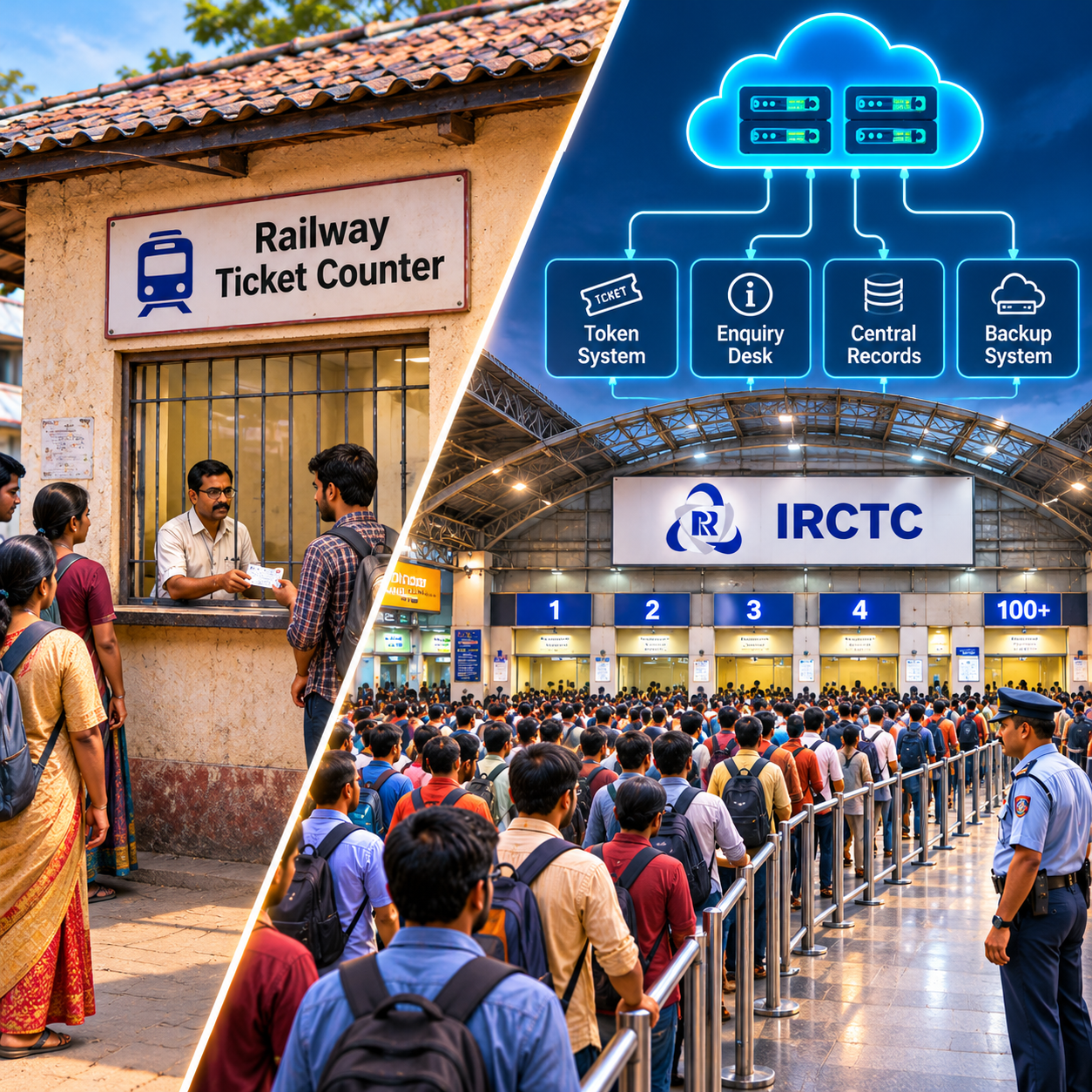
Picture a single railway ticket counter in a small town. One clerk, one window, one register. It works for a few dozen customers a day.

Now picture the same counter on the morning a festival rush begins, with a million people at the door. You would need hundreds of windows, a token system to keep order, guards to stop people pushing in, a separate desk for enquiries, a central record to ensure no berth is double-booked, and a backup office in case the building loses power. That is the difference between “one server” and a distributed system.

Frequently Asked Questions

Can’t a very powerful single server do the job?

No. Even the strongest machine has limits on connections, CPU, memory and network, and it would still be a single point of failure. Scaling up gets very expensive very quickly, while spreading the work across many machines is cheaper and more reliable.

Why does IRCTC still crash or lag at Tatkal time if it uses many servers?

Because demand spikes to many times normal capacity within seconds, and the core booking step, ensuring each seat is sold once, cannot be parallelised endlessly. Third-party dependencies like payment gateways and heavy bot traffic add pressure too.

Is IRCTC upgrading its system?

Yes. IRCTC has said the current system reached around 37,000 tickets per minute and an upgrade is planned to exceed one lakh per minute. Reports on how far the rollout has progressed differ, so check official announcements for the latest.

Will a faster website guarantee me a Tatkal ticket?

No. Tatkal inventory is small compared with the number of people trying, so most users will miss out even on a flawless system. A faster, more stable platform mainly makes the process more reliable and reduces failures, but it cannot create extra seats.

Key takeaways

  • IRCTC serves 70.6 million registered users and about 1.56 million tickets a day, but the real challenge is the Tatkal burst, when millions try to book a tiny inventory within seconds
  • One server fails for physical reasons (connections, CPU, memory, network), for burst reasons (peaks far above average), and for reliability reasons (a single point of failure)
  • The hardest problem is correctness: never selling the same berth twice, which forces carefully coordinated writes that do not scale just by adding machines
  • Search traffic dwarfs booking traffic, so systems separate the two, using caches for browsing and a protected core for booking
  • Real systems use load balancers, queues, caching, partitioned inventory, bot defence and disaster recovery, working together
  • Capacity figures vary between sources and are changing with the ongoing upgrade, so verify the latest numbers before quoting them