Technology

API Security in 2026: Why Authentication Alone Is No Longer Enough

API Security in 2026: Why Authentication Alone Is No Longer Enough

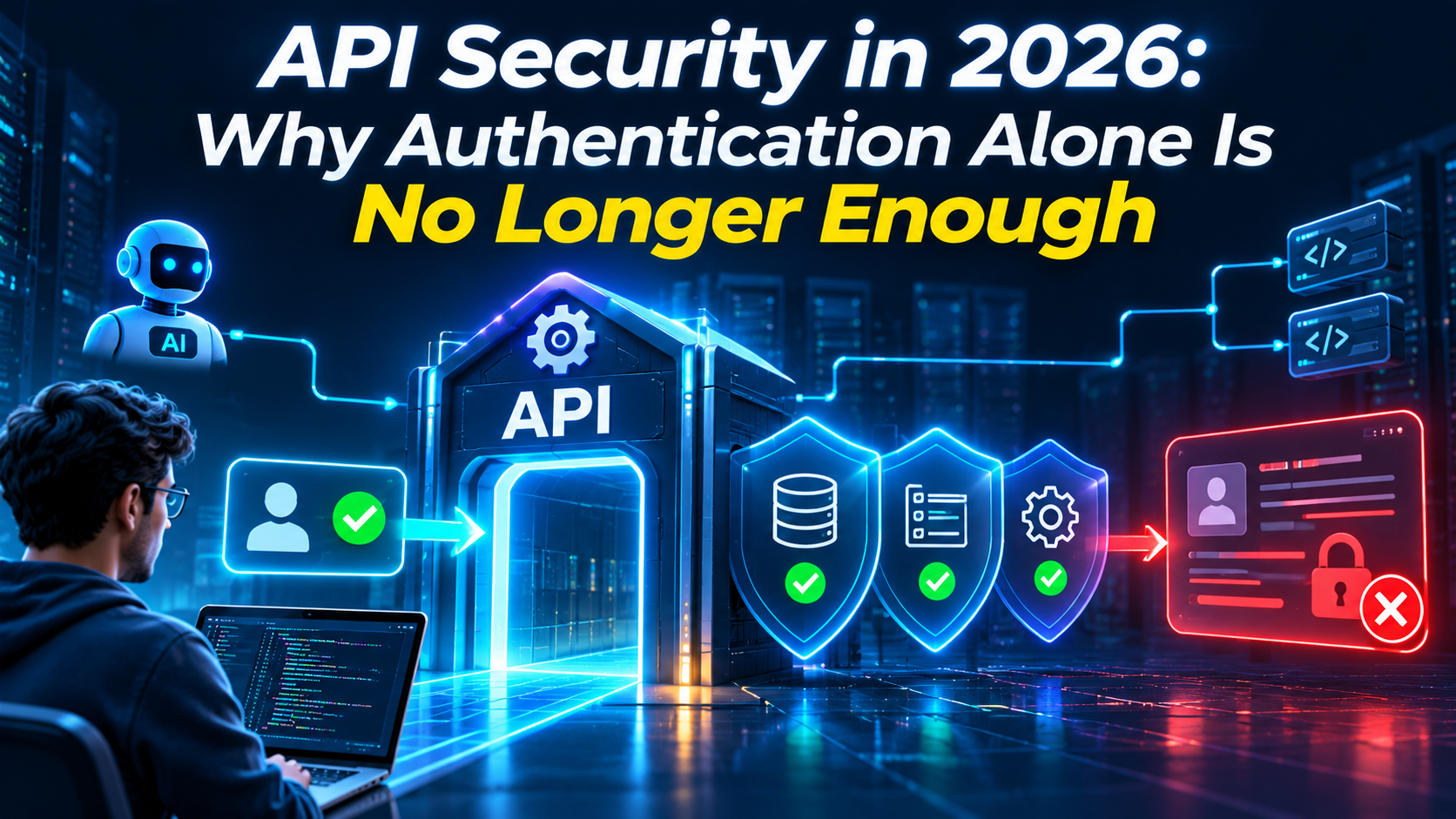
“Every request needs a valid token” sounds like a complete API security policy. It isn’t. Most serious API breaches today are not caused by an attacker slipping past the login screen. They happen after login, when a legitimate, authenticated caller asks for something they should never have been allowed to see or do, and the API simply says yes. As APIs multiply and AI agents become a new kind of API client, the gap between “who are you?” and “what are you allowed to do?” has become the central problem of API security. Here is what that gap looks like, why it keeps getting exploited, and how to close it.

The problem: a valid token is not the same as permission

Authentication answers one question: who is making this request? Authorization answers a different one: is this caller allowed to do this specific thing, to this specific resource, right now?

Many APIs do the first well and the second poorly. They verify the token, see a logged-in user, and then trust whatever that user asks for. An attacker only needs a normal account, which is often free to create, and then tries requests that other people’s data would answer.

The data points in this direction, though the figures should be read with care, because they come mostly from security vendors using different methods. One 2026 roundup claims that 95% of API attacks now originate from authenticated sessions using valid credentials. Whatever the exact figure, other sources show the same pattern: Salt Security data summarized by one analyst reports that 99% of organizations reported an API security issue in the past year and 80% of observed attack attempts mapped to the OWASP API Security Top 10. Akamai separately reported a 32% uptick in API attacks exploiting OWASP API Security Top 10 risks.

The lesson is simple: the front door is only part of the building.

Why the old model breaks down in 2026

Three shifts have made “just authenticate” less adequate than ever:

  1. There are far more APIs. Modern apps are collections of microservices, mobile backends, partner integrations and third-party services, each exposing endpoints. More endpoints mean more places to forget a check.
  2. APIs expose objects directly. A typical API call includes an identifier, such as an order number or user ID. If the server does not confirm that the caller owns that object, changing the number is enough.
  3. A new kind of caller has arrived. AI agents and automated workflows now call APIs on behalf of users, often with broad permissions and at machine speed. The next section covers this in more detail.

The OWASP API Top 10: mostly an authorization list

The OWASP API Security Top 10 (the 2023 edition is still the reference) reads like a catalogue of access-control failures. The ranking, as listed in one developer review, is: Broken Object Level Authorization, Broken Authentication, Broken Object Property Level Authorization, Unrestricted Resource Consumption, Broken Function Level Authorization, Mass Assignment, Security Misconfiguration, Injection, Improper Inventory Management and Unsafe Consumption of APIs.

Notice how many of those are about what an authenticated caller can reach. The ones that matter most for this article:

API1: Broken Object Level Authorization (BOLA). This is the top risk, and it has been since the list began. The pattern is always the same: an endpoint exposes an object ID, and the API does not verify that the authenticated user actually owns that object. It stays on top because it is easy to write by accident and hard to catch in traffic, where the malicious request looks like every other request. Measured shares vary by study. One analysis found BOLA in 12.5% of API vulnerability reports, while another roundup says it appears in over 40% of cases. Different datasets and definitions explain the gap, but all agree it is near the top.

API3: Broken Object Property Level Authorization (BOPLA). The caller is allowed to see an object, but not every field inside it. Returning an entire record, including internal flags, email addresses or pricing data, because “the frontend only displays some of it” is a classic mistake. Related is mass assignment, where an API blindly accepts any fields a client sends, such as a user setting their own “isAdmin” value.

API5: Broken Function Level Authorization (BFLA). A regular user can call an administrative function because the API only checks that they are logged in, not what role they hold. One 2026 breakdown found it in 10.5% of cases.

API4: Unrestricted Resource Consumption. Even perfectly authorized users can cause harm by hammering an endpoint, scraping data at scale, or triggering expensive operations. Without quotas and rate limits, a single valid account can become a data-extraction tool or a denial-of-service source.

API9: Improper Inventory Management. You cannot protect endpoints you do not know exist. Old versions, forgotten test endpoints and undocumented “shadow” APIs often skip the controls that production ones have.

API10: Unsafe Consumption of APIs. Your application also calls other APIs. If it trusts their responses blindly, a compromised or malicious upstream service can feed it harmful data.
What BOLA looks like in code

Here is a deliberately simple illustration of the mistake and its fix. This is defensive pattern guidance, not an exploit.

// VULNERABLE: authenticated, but no ownership check
app.get('/api/orders/:id', requireLogin, async (req, res) => {
  const order = await Order.findById(req.params.id);
  res.json(order); // any logged-in user can read any order
});

// SAFER: authorization is enforced against the caller
app.get('/api/orders/:id', requireLogin, async (req, res) => {
  const order = await Order.findOne({
    _id: req.params.id,
    userId: req.user.id        // the object must belong to the caller
  }).select('id status items total'); // return only allowed fields
  if (!order) return res.sendStatus(404);
  res.json(order);
});

Two small changes matter: the query is scoped to the authenticated user, and the response returns only approved fields. The same principle applies to every endpoint that takes an identifier

The new variable: AI agents as API clients

Until recently, API clients were mostly human-driven apps and scripted integrations. Now autonomous agents call APIs directly, chain calls together and operate at machine speed. That raises concerns on several fronts:

  • Developers are worried. One 2026 summary reports that 51% of developers cite unauthorized API calls from AI agents as their top security concern, and 49% worry about AI systems accessing sensitive API data without proper controls.
  • AI-related issues are growing fast. Wallarm’s 2026 report, as summarized by one analyst, frames a 398% year-over-year growth in AI-related vulnerabilities, with 36% of those involving APIs, and industry reports increasingly flag AI-generated API key abuse, prompt-injection paths through APIs and rogue MCP servers as the next phase of API risk.
  • AI-written code can repeat mistakes. Security vendors warn that when coding agents generate APIs, shadow APIs proliferate because agents create endpoints that are never catalogued, BOLA appears at scale because agents implement authorization patterns from training data rather than your access control model, and secrets get hardcoded. That is one vendor’s perspective, but it matches a sensible concern: generated code still needs review against your own authorization rules.

The key point for design: an agent calling your API with a user’s token is still just a caller. If authorization is weak, the agent can reach everything the token can reach, and the agent may do it faster, more broadly and with less human oversight than a person would.

What to do instead: layered API security

If authentication is only the first layer, what are the others? Think in terms of a stack.

1. Strong authentication (necessary, not sufficient)

  • Use standard protocols such as OAuth 2.0 and OpenID Connect rather than home-made schemes.
  • Prefer short-lived access tokens with refresh flows, and rotate or revoke credentials promptly.
  • Use mutual TLS or similar controls for service-to-service traffic.
  • Never hard-code secrets or put keys in client-side code.

2. Authorization on every request, at three levels

  • Object level: verify the caller may access this specific record.
  • Property level: return and accept only the fields the caller is permitted to read or change.
  • Function level: check role and scope for every operation, especially administrative ones.
  • Centralize policy where possible, so rules are consistent rather than re-implemented in each endpoint.

3. Least privilege everywhere

  • Issue narrowly scoped tokens, particularly for agents and integrations. A token that can “do everything” is a liability.
  • Separate read and write scopes, and give agents only the actions they need.

4. Limits and abuse controls

  • Apply rate limits, quotas and cost controls per user, per token and per IP.
  • Detect scraping and enumeration, such as one account requesting thousands of sequential IDs.
  • Protect expensive endpoints, such as search, export and password reset.

5. Input and output discipline

  • Validate requests against a schema (for example your OpenAPI definition) and reject anything unexpected.
  • Use unpredictable identifiers, such as UUIDs, as a helpful extra layer, though never as a substitute for authorization checks.
  • Filter responses so sensitive fields are never returned by default.

6. Know your inventory

  • Maintain a living catalogue of every API, version and owner, including internal and partner ones.
  • Retire old versions and test endpoints, and scan for undocumented “shadow” APIs.

7. Monitor behavior, not just signatures

Because BOLA-style requests look like normal traffic, detection depends on context. Log who accessed what, and alert on unusual patterns: a user touching many different objects, access from odd locations, or sudden spikes in volume.

8. Test authorization in your pipeline

Because these flaws are introduced in code, during development, the control point is the developer workflow. Add automated tests that log in as one user and try to access another user’s resources, and fail the build if the API returns anything other than a denial.

A quick self-check

Ask your team these questions:

  • If I log in as User A and change the ID in a request to one belonging to User B, what happens?
  • Can a normal user call an admin endpoint if they know the URL?
  • Does any response include fields the client does not need?
  • Do we know every API we expose, including old versions?
  • What can our AI agents and integrations actually do with the tokens we give them?
  • Would we notice if one valid account quietly downloaded thousands of records?

If you are unsure about any answer, that is where to start.

Frequently Asked Questions

If my API requires login, isn’t it secure?

Not necessarily. Login proves identity, but many serious API flaws occur after login, when the API fails to check whether the user is allowed to access a specific object, field or function. Authentication and authorization are separate controls, and you need both.

What is BOLA and why is it so common?

Broken Object Level Authorization happens when an API lets a user access another user’s data by changing an identifier in the request. It is common because it is easy to forget the ownership check in a single endpoint, and the malicious request looks just like a normal one, so firewalls and basic monitoring often miss it.

Do random IDs like UUIDs solve the problem?

They help by making IDs harder to guess, but they do not fix it. If an ID leaks through a link, a log or another API response, the attacker can still use it. Always enforce authorization checks on the server.

How should I secure APIs that AI agents will use?

Treat agents as untrusted callers. Give them narrowly scoped, short-lived tokens, enforce object-, property- and function-level checks as you would for any client, apply rate limits, log their activity, and review any API code that an AI assistant generates against your authorization rules.

Key takeaways

  • Authentication proves who is calling; authorization decides what they may do, and most serious API breaches exploit weak authorization after a valid login
  • Broken Object Level Authorization has led the OWASP API Top 10 since its inception, and most of the list concerns access control and abuse rather than login failures
  • Statistics vary widely by source and method, but they consistently show that attackers often use valid credentials and normal-looking requests
  • AI agents add a new class of API client that can act broadly and quickly, so token scoping and server-side checks matter even more
  • Layer your defenses: strong auth, object-, property- and function-level authorization, least privilege, rate limits, schema validation, inventory management and behavioral monitoring
  • Test authorization automatically in your CI pipeline, because these flaws are introduced during development