Technology

Best ERP for Colleges — And Why APERP Is Built to Be It

Best ERP for Colleges — And Why APERP Is Built to Be It

If you're a college registrar, director, or HOD still juggling paper attendance registers, spreadsheet-based fee tracking, and a scramble every accreditation cycle to compile CO-PO data by hand — you already know generic admin software isn't built for how a campus actually runs. In this piece, we break down what actually makes an ERP the best fit for a college, then walk through how APERP ERP — built specifically for academic institutions, from CBCS curricula to biometric attendance to NAAC/NBA reporting — solves exactly that.

The problem every college eventually runs into

Ask any registrar, HOD, or college director what a normal week looks like, and you'll hear some version of the same story: attendance registers that live in three different formats, a finance office chasing fee dues off a separate spreadsheet, faculty compiling marks by hand, and an accreditation audit looming that needs CO-PO attainment data nobody has been tracking in real time.

None of this is because the people running the college are disorganized. It's because the software they're using was never built for a college — it's a general-purpose admin tool, or a patchwork of five different point solutions that don't talk to each other. The result: data inconsistencies between departments, faculty burning hours on tasks that should take minutes, and management making decisions without a real-time view of what's actually happening on campus.

That's the exact gap a genuinely good college ERP needs to close — and it's worth defining precisely what "best" means before naming a product.
What actually makes an ERP the best fit for a college

Not every ERP that claims to work "for education" is built around how a college actually functions. Based on the failure points institutions run into most, a few criteria separate a system that genuinely fits from one that just gets tolerated:

  1. It models academic reality, not generic business processes. A college isn't a company with "departments" — it has semesters, credit systems, electives, grading scales, and accreditation frameworks that a corporate ERP was never designed to represent.
  2. It's outcome-based-education (OBE) native. If mapping Course Outcomes and Program Outcomes to NBA/NAAC requirements means bolting on a separate spreadsheet exercise every audit cycle, the ERP isn't doing its job.
  3. It's modular, not all-or-nothing. A college should be able to roll out attendance and admissions first, then add library, hostel, or transport modules later — without a second implementation project.
  4. It reduces faculty admin load, not adds to it. If a teacher spends more time fighting the software than they save from it, the tool has failed its most important user.
  5. It gives management real-time visibility. Fee collection, attendance trends, staff leave, compliance status — directors shouldn't need to request a report to see where the institution stands today.
  6. It keeps every campus's data properly isolated and secure. Multi-campus institutions in particular need strict separation between what one campus's admins can see and another's.
  7. It has a support and implementation model built around education, not a generic enterprise onboarding process that assumes finance-team users instead of registrars, wardens, and librarians.

Measured against that list, this is where APERP ERP was built to sit.

So what exactly is APERP

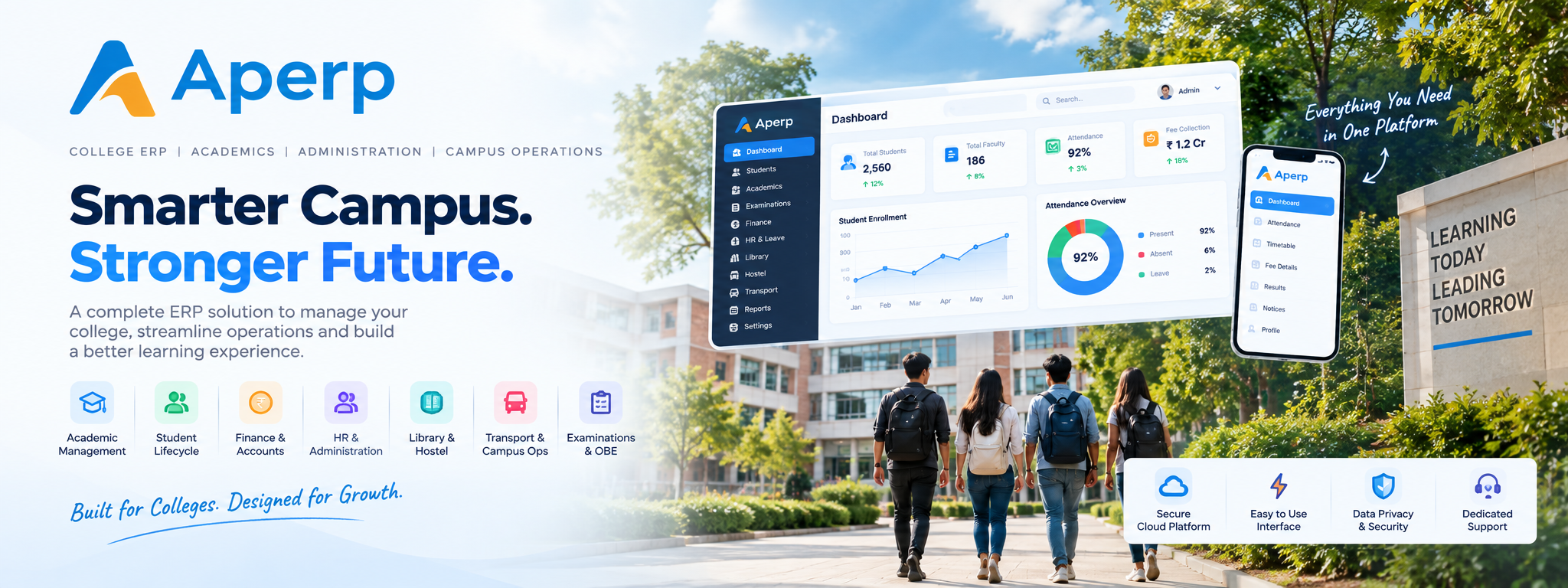
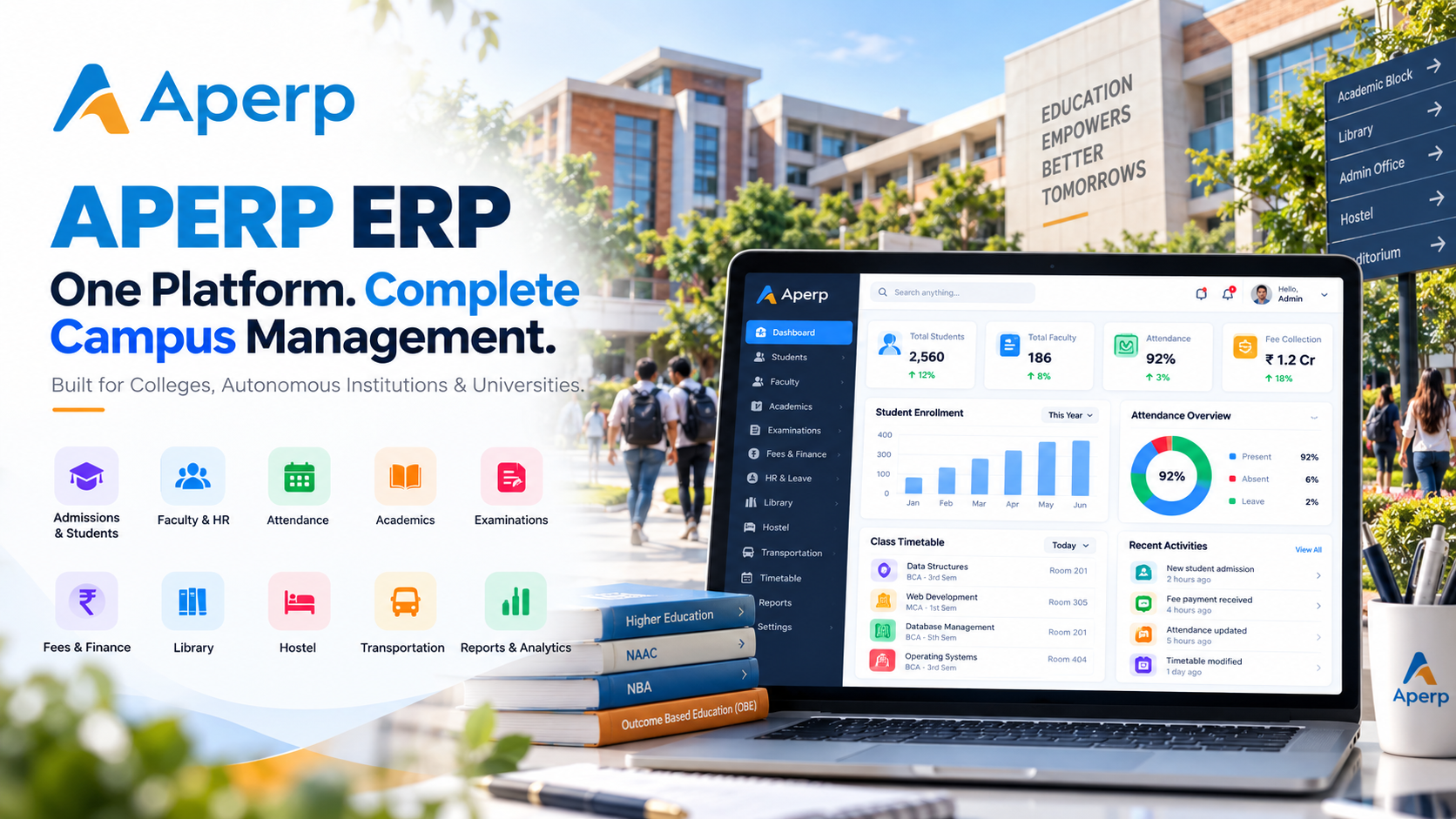
APERP ERP is a cloud-based Enterprise Resource Planning platform built by APERP Technologies India Pvt Ltd, designed specifically to run the academic and administrative operations of colleges, autonomous institutes, and universities. Rather than adapting a generic business ERP for education, APERP was modeled from the ground up around how academic institutions actually work — covering the full student lifecycle from admission through graduation, alongside finance, HR, library, hostel, transport, and examinations, all on one secure platform.

At its core, APERP operates as a single source of truth: one database that management, registrars, faculty, students, parents, and non-academic staff all draw from, each seeing only what's relevant to their role.

How APERP actually works — the module breakdown

APERP isn't one monolithic tool; it's a set of interconnected modules that together cover the whole campus:

  • Academic Management — curriculum and daily/weekly syllabus coverage tracking (Abstracts).
  • Student Lifecycle — admissions and enrollment, semester registration and attendance (manual or biometric), and exit/certificate services like Bonafide Certificates and English Proficiency Letters.
  • HR & Administration — employee registry, leave management (HRMS), lecture-swap workflows when a faculty member is on leave, and biometric work-hour logging feeding directly into payroll.
  • Campus Operations — library cataloging and circulation, hostel room allocation and vacancy tracking, and transport route/bus-stop management.
  • Learning & Examination — internal and external exam configuration, an online quiz/MCQ engine, and a CO-PO accreditation calculator built around Bloom's Taxonomy levels.

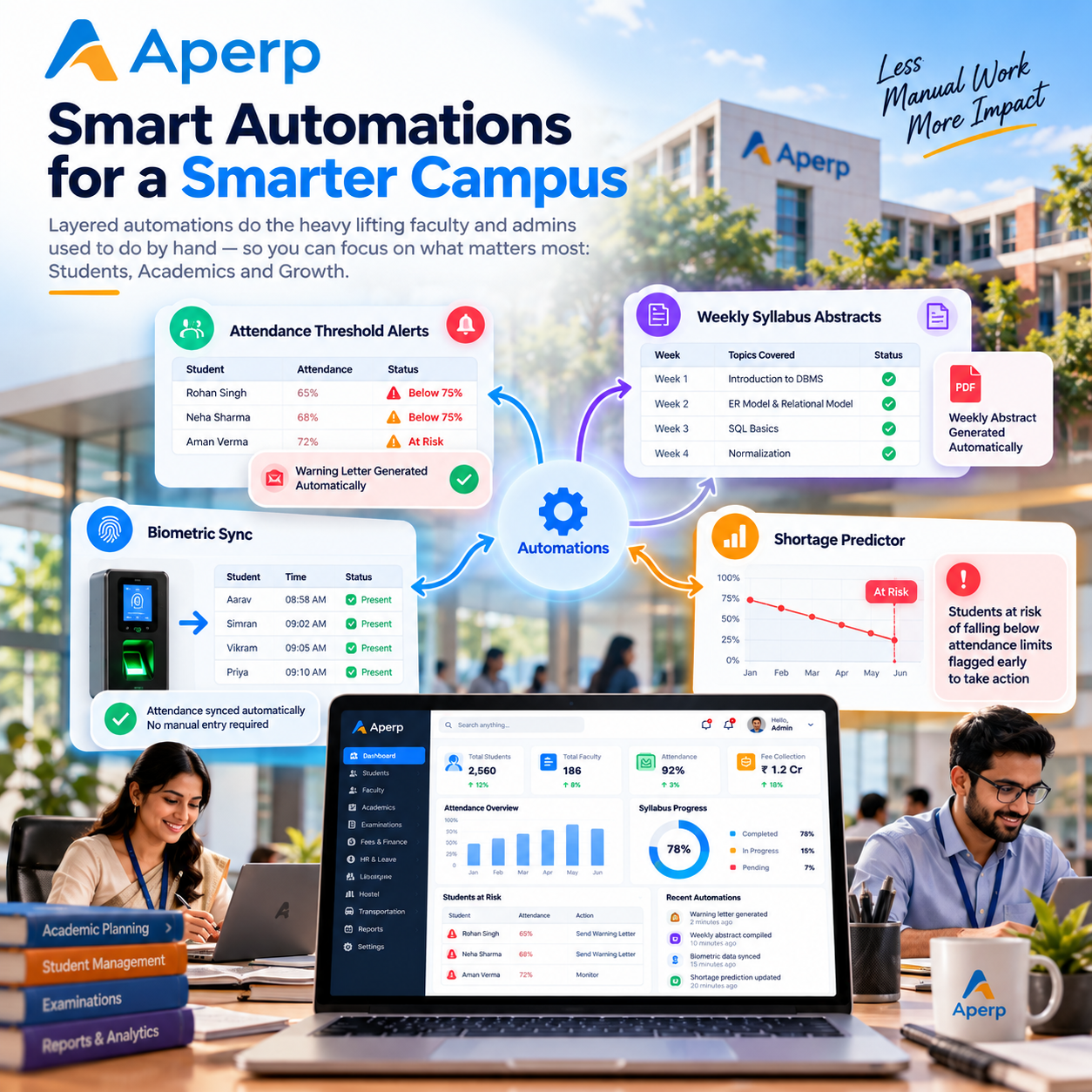
Layered on top, a set of automations do the heavy lifting faculty and admins used to do by hand: attendance-threshold alerts that auto-generate warning letters, weekly syllabus abstracts compiled from daily logs, biometric sync that eliminates manual attendance entry, and a shortage predictor that flags students at risk of falling below attendance limits early enough to intervene.

Built for the institution type, not a generic campus

APERP's modules flex differently depending on what kind of institution is running them:

  • Engineering colleges get automated NAAC/NBA attainment reporting.
  • Universities get centralized department management across schools (Engineering, Sciences, Arts, Management) with consolidated academic records and accounting views.
  • Autonomous institutions get independent grading formulas (relative or absolute), flexible syllabus control, and on-demand certificate printing.
  • Multi-campus institutions get strict per-campus data segregation, with directors getting a consolidated view across all campuses from one dashboard.

Security, and why data segregation matters here specifically

Because APERP holds student records, financial ledgers, and staff payroll for potentially multiple institutions, security isn't an afterthought — it's structural. Data in transit is encrypted over HTTPS; data at rest (including file attachments) is encrypted with AES; passwords are one-way hashed. Each college or university runs on its own isolated database, so one institution's records are never reachable from another's — a non-negotiable for any multi-tenant education platform. The whole system runs inside isolated Virtual Private Clouds with restricted network access, and daily automated backups are encrypted and shipped off-site.

It connects to what the campus already has

APERP doesn't ask a college to rip out its physical infrastructure — it syncs with it. Biometric terminals feed attendance logs directly into the database. SMS and email gateways handle low-attendance warnings, exam schedules, and OTPs. Bulk spreadsheet import/export covers everything from student registries to payroll parameters, so migrating off legacy systems doesn't mean re-typing years of records by hand.

Where it's already working

  • An engineering college replaced manual attendance files with APERP, cutting semester report compilation from days to minutes.
  • An autonomous institute used the CO-PO mapping engine to automate outcome attainment calculations, saving weeks of faculty work during an NBA/NAAC audit.

College directors report better real-time visibility into fees, staff attendance, and exam grades; registrars point to automated certificate generation saving hours of manual typing; faculty note that marking attendance and uploading marks now takes minutes instead of a chunk of their day.

Key takeaways

  • A genuinely good college ERP has to model academic reality — CBCS, OBE, grading scales, accreditation — not adapt a generic business tool
  • It covers the full campus: academics, student lifecycle, finance, HR, library, hostel, transport, and exams, in one connected system
  • Automation (attendance alerts, syllabus abstracts, CO-PO calculations) is what actually cuts faculty admin time, not just digitizing paper
  • Data segregation per institution and AES/HTTPS encryption make it viable for multi-campus and multi-tenant deployments

Next step

If your institution is still stitching together spreadsheets, a legacy system, and manual registers, the question isn't whether to move to an ERP — it's whether the one you pick was actually built for a college. A demo, scoped to your enrollment size and department structure, is the fastest way to find out.