Each mobile generation tends to fix the previous one’s limits. 4G made mobile video normal. 5G added higher capacity, lower delay and the ability to connect many devices. But some gaps remain:
Beyond 5G: How 6G Technology Could Transform Global Connectivity
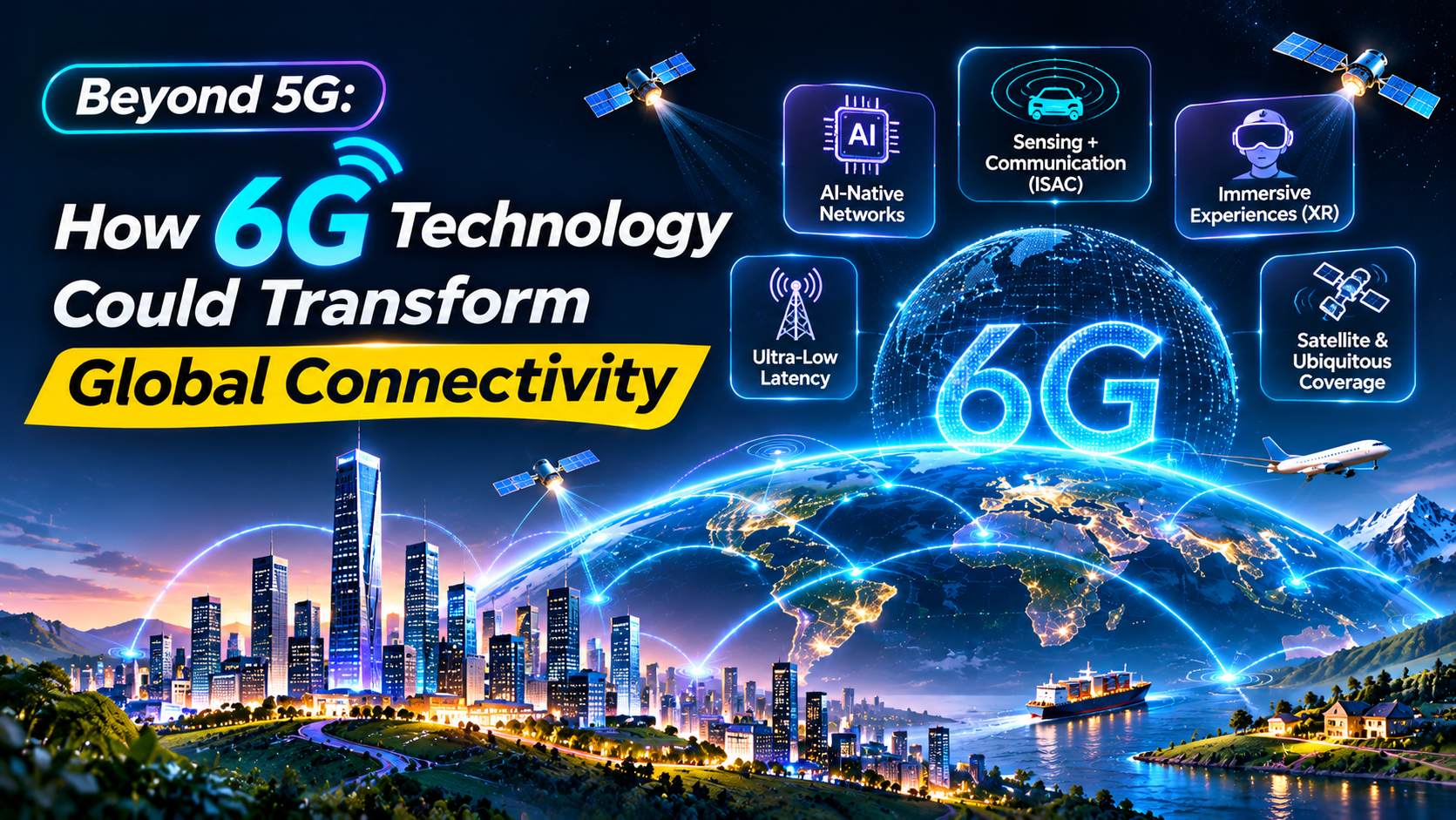
5G promised to change everything, and it delivered something more modest: faster phones, better capacity, and a handful of industrial use cases. Now the telecom industry is already planning the next leap. 6G is not just “5G but faster”. The ambition is a network that senses its surroundings, runs on built-in AI, and stretches from city towers to satellites so that fewer places are left without a signal. This article explains what 6G is meant to be, where the standards stand today, what could genuinely change, and what is still hype.
The problem: 5G solved speed, but not everything else
- Coverage: large parts of the world, including oceans, mountains, deserts and remote villages, still have weak or no mobile signal.
- Sensing: networks move data, but they do not natively “see” what is happening in the physical space around them.
- Complexity: running a modern network is hard, and operators rely on more and more manual tuning and rule-based automation.
- Demanding applications: immersive extended reality, real-time industrial control, and large fleets of autonomous machines push the limits of today’s reliability and latency.
6G is the attempt to address these together, rather than just adding more bandwidth.
What is 6G, officially?
6G is not a single product. It is a framework and a set of standards being defined by international bodies. The global umbrella is the ITU’s IMT-2030 framework, while the engineering is done mainly by 3GPP, the group that wrote the 4G and 5G standards.
The ITU framework is worth understanding because it shows the intent. One summary says that the IMT-2030 framework now includes 20 minimum technical performance requirements spanning six usage scenarios: immersive communication, hyper-reliable low-latency communication, massive communication, ubiquitous connectivity, AI and communication, and integrated sensing and communication.
Compare that with 5G’s three scenarios (faster broadband, massive device connections, ultra-reliable low latency). The last three items on the 6G list are the genuinely new ideas.
The big ideas behind 6G
1. AI-native networks
In 5G, AI is added on top to optimize things. The 6G idea is to build it in from the start. One research paper describes this as a model in which artificial intelligence is not merely an auxiliary optimization tool but a foundational architectural element. In practice, that could mean the radio layer itself uses learned models for tasks like channel estimation, beam prediction and scheduling, and that networks manage and heal themselves with far less human intervention.
Researchers describe a gradual path rather than an overnight switch. One maturity model puts the early stage as AI augmenting blocks within a conventional specification, such as neural channel estimation, learned CSI compression and beam prediction, with fully AI-native end-to-end designs coming later, around 2029 to 2032 and beyond. That is a research framing rather than an approved commitment, but it shows how cautious the engineering path is.
2. Integrated sensing and communication (ISAC)
This is one of the most distinctive 6G concepts: the network’s radio signals do double duty. Besides carrying data, they can detect objects, movement and surroundings, a bit like radar built into the mobile network. 3GPP’s early groundwork looked at this directly. In Release 19 it planned a study on channel modelling for integrated sensing and communication, a key 6G usage scenario that integrates sensing capabilities to obtain spatial information about connected or unconnected objects and their environments.
Possible uses include detecting drones or intruders, monitoring traffic flow, assisting autonomous vehicles and mapping indoor spaces, though many of these remain concepts rather than products.
3. Ubiquitous connectivity through satellites and non-terrestrial networks
This is the “global connectivity” part of the story. 6G is designed from the beginning to blend terrestrial towers with satellites and other platforms, so a phone could move between them smoothly. The groundwork is already visible in 5G-Advanced, where NTN integration with terrestrial networks is one of the key components of Release 19, and enabling voice calls over GEO satellites using NB-IoT technology has attracted attention in Release 20.
If it works as intended, this could reduce coverage gaps in remote regions, at sea and in the air, and improve resilience when ground infrastructure fails in disasters.
4. New spectrum, including mid-band and higher frequencies
More capacity needs more spectrum. 3GPP has already planned studies on channel modelling for 7-24 GHz spectrum to prepare for 6G standardization. Higher frequencies bring more bandwidth but shorter range and tougher engineering, which is why spectrum remains one of the open questions.
5. Immersive and massive-scale applications
The immersive communication scenario points to extended reality, holographic-style experiences and richer remote collaboration. The massive communication scenario points to enormous numbers of sensors and devices. A related 5G-Advanced theme is ambient IoT, which enables ultra-low-power and battery-less IoT devices, an area expected to grow as networks head toward 6G.
Where the standards stand today
It is easy to read breathless headlines and assume 6G is imminent. The standards process says otherwise.
- 3GPP Release 20 is the study phase. One analysis explains that Release 20 is the study phase for foundational 6G technologies, and Release 21 will contain the first normative 6G specifications.
- Specifications arrive later in the decade. Based on the timeline agreed in June 2026, technical studies should conclude across 3GPP groups during the first half of 2027, with specification work continuing through late 2028 and final review extending into early 2029. The same source says the timeline points toward implementable specifications in early 2029.
- The ITU process runs in parallel. IMT-2030 expects technology proposals around 2029, with 2030 for full system definition.
- Commercial launch is around 2030. The general expectation is that the years that follow will carry the standard from the laboratory toward global trials and commercial launch around 2030.
The same analysis offers an important caution: none of that means the 6G standard is settled, as Release 20 is explicitly a study phase and major questions around spectrum, AI implementation, sensing architecture and commercialization remain open.
In the meantime, the industry is pushing 5G-Advanced, which is where many 6G building blocks, such as AI features, sensing studies and satellite integration, are first being tested.
What could actually change for people and businesses
Keeping in mind that all of this depends on delivery, here are the areas where 6G could matter most.
Wider, more resilient coverage. If satellite and terrestrial networks integrate well, more people in rural and remote regions could connect, and emergency services could stay online when local infrastructure is damaged. For countries with large rural populations, such as India, this is a significant part of the interest in 6G, and national programs have been set up to shape the standard and develop local capability.
Smarter, self-managing networks. AI-native operation could mean fewer outages, faster fault fixing and more efficient use of spectrum and energy, which matters because networks consume large amounts of power.
New services built on sensing. If networks can reliably sense their environment, new services become possible: safer traffic systems, smarter factories, better monitoring of infrastructure and improved safety applications.
Industrial and enterprise use. Factories, ports, hospitals and logistics hubs may benefit from the very high reliability and low delay that 6G aims for, especially in private networks designed for specific sites.
Immersive experiences. Extended reality, telepresence and richer remote work could become more practical, if devices and content catch up.
The reality check
6G comes with serious challenges, and honest coverage should include them.
- Timelines are long. Standards first, then chips, then network equipment, then devices. Using 5G as a guide, one analysis notes that 5G standalone was standardized in 2018, yet meaningful handset penetration came in 2022 to 2023, and so it concludes consumer AI-native services at scale are an objective for around 2030 and beyond. Do not expect to buy a 6G phone and see everything on this list in 2030.
- Peak-speed headlines are vision numbers. Claims of terabit-per-second speeds describe theoretical or lab conditions. Real-world experience depends on spectrum, coverage, cost and how networks are built.
- Higher frequencies are harder. More bandwidth often means shorter range and more base stations, which raises cost.
- Energy and sustainability. A bigger, denser, AI-heavy network must be efficient, or its power use will become a problem.
- Security and privacy. Sensing networks and AI-native systems raise new questions about surveillance, data protection and attack surface. Cryptography will also need to be ready for the post-quantum era.
- Uneven rollout. New generations usually reach wealthy markets and dense cities first. Whether 6G narrows or widens the digital divide depends on policy, pricing and satellite economics, not just technology.
- Open standards questions. Spectrum allocation, the exact role of AI in the air interface, and how sensing will be architected are still being decided.
5G, 5G-Advanced and 6G at a glance
| 5G | 5G-Advanced | 6G | |
|---|---|---|---|
| Status | Widely deployed | Rolling out now (3GPP Releases 18 to 20) | In study phase; first specifications expected around 2029 |
| Focus | Speed, capacity, low latency, many devices | AI/ML features, better MIMO, satellite integration, ambient IoT | AI-native design, integrated sensing, ubiquitous coverage, immersive and massive scenarios |
| ITU usage scenarios | 3 | Extensions of 5G | 6 |
| Commercial timing | Since 2019 | 2024 onward | Around 2030 |
What should businesses and developers do now?
You do not need to wait for 6G to prepare.
- Get the most from 5G and 5G-Advanced. Private networks, edge computing and low-latency applications can be built today.
- Design for connectivity variety. Build apps that can handle changing network quality, including satellite links with higher latency.
- Watch the standards. Follow 3GPP Release 20 and 21 and the ITU IMT-2030 process, especially for sensing, AI and satellite features.
- Invest in data and edge AI skills. AI-native networks and sensing services will reward teams that can work with real-time data.
- Plan security early. Including post-quantum readiness, device identity and privacy-by-design.
Frequently Asked Questions
When will 6G launch?
The current plan points to first commercial launches around 2030. 3GPP Release 20 is the study phase, Release 21 is expected to produce the first 6G specifications, and implementable specs are projected for early 2029. Mass consumer availability will likely come later still.
How is 6G different from 5G?
5G focused on speed, capacity and low latency. 6G aims to add AI built into the network, integrated sensing (using radio signals to detect the environment), and seamless coverage that blends towers with satellites, along with more extreme reliability, massive connectivity and immersive use cases.
Will 6G be much faster than 5G?
Higher peak speeds are a goal, but headline figures are theoretical. Real-world gains will depend on spectrum, network design and cost. The bigger changes may be in coverage, reliability, intelligence and new services rather than raw download speed.
Will 6G bring internet to remote areas?
It could help, mainly through tighter integration of satellite and terrestrial networks. Whether that lowers the digital divide in practice depends on pricing, device availability, regulation and how quickly operators deploy.
Key takeaways
- 6G is a framework being defined by the ITU (IMT-2030) and 3GPP, not a finished standard; Release 20 is the study phase and Release 21 brings the first specifications
- The six IMT-2030 usage scenarios add AI and communication and integrated sensing and communication to 5G’s themes
- The big ideas are AI-native networks, sensing built into the radio layer, satellite and terrestrial integration, new spectrum, and immersive and massive-scale applications
- Implementable specifications are expected around early 2029, with first commercial launches around 2030
- Based on 5G’s history, widespread device and service adoption will take years after launch
- Challenges include cost, higher-frequency engineering, energy use, security and uneven rollout
- Much of the groundwork is already visible in 5G-Advanced, which is the practical place to start preparing