Most application security rests on two families of cryptography:
Beyond Traditional Encryption: How Post-Quantum Cryptography Will Change Application Security
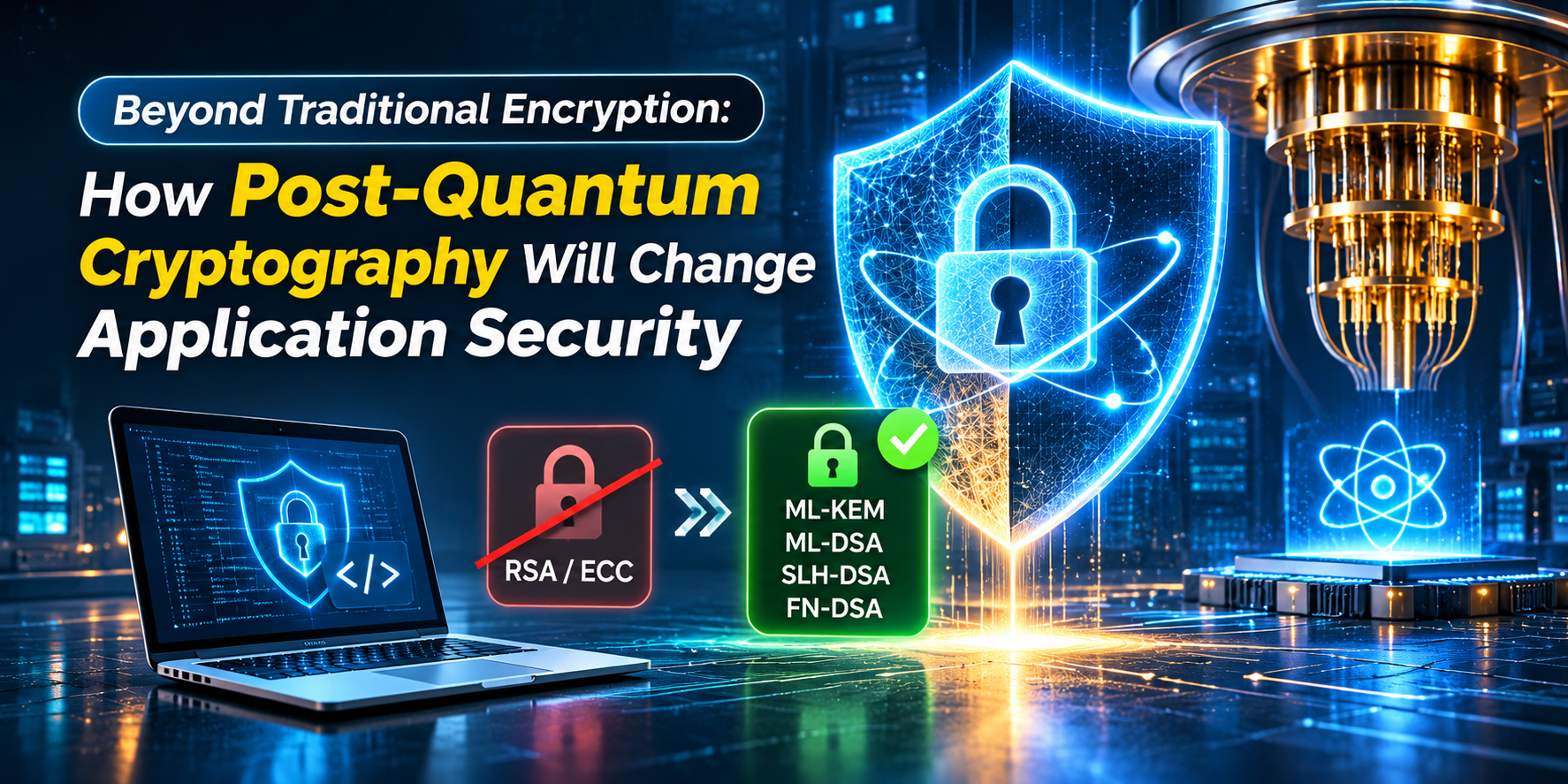
Almost every secure thing your application does, from loading an HTTPS page to verifying a software update, depends on math problems that today’s computers cannot solve. A large enough quantum computer could. Nobody knows exactly when that machine will exist, but governments and standards bodies have stopped waiting to find out, and the migration deadlines are now written down. This article explains what quantum computing actually threatens, what the new post-quantum standards are, and what changes for the developers and security teams who build and protect applications.
The problem: today’s encryption has a shelf life
- Public-key cryptography (RSA, Diffie-Hellman, elliptic curves) is used to set up secure connections, exchange keys, and create digital signatures. It underpins TLS, certificates, SSH, VPNs, code signing, and signed tokens.
- Symmetric cryptography (such as AES) is used to encrypt the data itself once a secure channel exists.
The two are affected differently by quantum computers. A sufficiently powerful quantum machine running Shor’s algorithm could break the public-key side, including RSA and elliptic curves, in a practical amount of time. Symmetric encryption is hit far less: quantum attacks roughly halve its effective strength, which is why 256-bit keys are generally considered a safe answer. So the focus of post-quantum work is on replacing public-key cryptography, not on abandoning encryption altogether.
Importantly, a quantum computer capable of doing this does not exist today, and no one can say with confidence when it will. The reason to act now is not a countdown; it is the next problem.
“Harvest now, decrypt later”
Attackers do not need a quantum computer today to benefit from one tomorrow. They can record encrypted traffic now and store it, planning to decrypt it once the technology arrives. For data that must stay confidential for many years, such as health records, financial data, government or defense information, trade secrets and long-lived credentials, that makes the risk real already. If the information will still matter in 10 or 15 years, traffic captured today could be exposed later.
Signatures are a slightly different story. A forged signature only matters once it can be forged, so the urgency there is about being ready before that point, especially for long-lived systems like firmware, root certificates and devices that cannot be easily updated.
The new standards: what replaces RSA and elliptic curves
After a multi-year global competition, NIST published its first post-quantum standards in August 2024. Three finalised standards (FIPS 203, 204 and 205) were published, with a fourth signature algorithm, Falcon, being standardised as the forthcoming FIPS 206 (FN-DSA). In plain terms:
| Standard | Algorithm | Job | Replaces |
|---|---|---|---|
| FIPS 203 | ML-KEM (formerly Kyber) | Key establishment | RSA key exchange, Diffie-Hellman, ECDH |
| FIPS 204 | ML-DSA (formerly Dilithium) | General digital signatures | RSA, ECDSA, EdDSA signatures |
| FIPS 205 | SLH-DSA (formerly SPHINCS+) | Hash-based signatures, a conservative backup | Same, with different math assumptions |
| FIPS 206 (draft) | FN-DSA (Falcon) | Compact signatures | Same |
ML-KEM and ML-DSA are built on lattice problems, which are believed to be hard for both classical and quantum computers. SLH-DSA is based only on hash functions, so it gives a safety net that does not depend on lattice math. That diversity matters: if a weakness were ever found in one family, the other would still stand.
NIST has also made a practical recommendation. Its final guidance designates ML-KEM-768 as the recommended default parameter set, offering a large security margin at a reasonable performance cost, giving vendors and buyers a common baseline.
The clock is now official
Timelines have hardened. On 27 October 2026, NIST published the final version of NIST IR 8547, Transition to Post-Quantum Cryptography Standards. The key dates in the final roadmap, as summarised by Quantum Computing Report, include binding deadlines for federal agencies to adopt post-quantum cryptography for key establishment by 31 December 2030 and for digital signatures by 31 December 2031, with the older quantum-vulnerable algorithms deprecated and then disallowed by the end of 2035.
cryptonext-security
quantumcomputingreport
On the policy side, OMB Memorandum M-26-15, issued on 24 June 2026, required agencies to submit migration plans within 120 days and laid out a five-phase program running from discovery in 2026 and 2027 to full migration in 2035. The goal, first set in a 2022 White House memo, is to mitigate as much of the quantum risk as feasible by 2035.
cloudsecurityalliance
arxiv
These rules formally apply to US federal systems, but they ripple outward. Vendors, cloud providers and contractors that sell to government will need to comply, and the dates give everyone else a reasonable planning horizon. Other regions, including the EU, Canada and others, have published their own roadmaps as well.
What actually changes in application security
Here is where it gets practical. Post-quantum cryptography is not a single switch; it touches several layers of how applications are built and protected.
1. Transport security (TLS) moves first
TLS is the first place most organizations will feel the change, because it is the most exposed to harvest-now-decrypt-later attacks. NIST’s final guidance presents TLS 1.3 as the most direct path to quantum-resistant key establishment, including through hybrid mechanisms that pair ML-KEM with a classical algorithm. Hybrid is the key idea: the connection combines a classical exchange (like X25519) with ML-KEM, so it stays secure if either one turns out to be broken. The guidance also advises that hybrid key-exchange mechanisms be deployed immediately.
The good news is that this is already happening at scale. A 2026 measurement study notes that large deployments by providers such as Google and Cloudflare have shown that hybrid X25519 and ML-KEM-768 key exchange introduces minimal performance overhead while protecting against both classical and quantum adversaries. For many web applications, support may arrive largely through updated browsers, CDNs, load balancers and TLS libraries, rather than through rewritten application code.
2. Certificates and PKI are harder
Key exchange protects the confidentiality of today’s traffic. Certificates and signatures prove identity. Moving these is more complex because of the whole certificate ecosystem: root authorities, intermediate certificates, browsers, devices and the chains of trust between them. Post-quantum signatures are also larger than the ones we use today; a typical ML-DSA signature is a few kilobytes, compared with tens of bytes for ECDSA. That affects handshake sizes, certificate chains and anything with tight size limits.
3. Code signing, firmware and software updates
Anything that must stay trustworthy for years, such as signed firmware, boot loaders, software update channels and long-lived devices, is a priority, because you cannot easily replace the trust anchor in a device already shipped. If your product has a long lifetime in the field, this is where early planning pays off. The US National Security Agency’s CNSA 2.0 requirements, for example, already single out software and firmware signing and TLS for web and cloud services as early adopters of quantum-resistant algorithms
4. Tokens, JWTs, API authentication and SSO
Many applications rely on signed tokens such as JWTs, SAML assertions, or API request signatures. These typically use RSA or ECDSA today. Over time they will need post-quantum or hybrid signature options, and the larger signature sizes will matter for things like HTTP headers, cookies and mobile payloads that have practical length limits.
5. SSH, VPNs, messaging and email
Remote access, VPNs, secure messaging and email encryption all use public-key methods and will migrate to hybrid or post-quantum versions as the protocols and implementations catch up.
6. Data at rest is mostly fine, but key management is not
Encrypting stored data with strong symmetric algorithms remains sound. What changes is how keys are wrapped, exchanged and protected. Hardware security modules, key management services and backup systems that rely on RSA or elliptic curves to protect those keys will need updating.
7. Your supply chain and dependencies
Your application’s security depends on libraries, frameworks, operating systems, cloud services and third-party APIs you may not control. If a dependency does not support post-quantum algorithms, you may be stuck regardless of your own code. This is why asking vendors for their post-quantum roadmaps is becoming a standard part of security reviews.
The hard parts nobody should ignore
- Bigger keys and signatures. Post-quantum keys, ciphertexts and signatures are larger than their classical counterparts. For ML-KEM-768, the public key and ciphertext are each on the order of a kilobyte. That can affect network packets, storage, mobile data and embedded devices.
- Legacy systems. The same measurement study finds that many organizations continue to support TLS 1.2 to maintain compatibility with legacy systems, embedded devices, older operating systems and long-lived enterprise applications, even though TLS 1.3 is better suited to hybrid post-quantum key exchange. Old systems that cannot be upgraded may need to be replaced or isolated.
- The barrier is operational, not mathematical. The same study concludes that the primary barriers to adoption are no longer the absence of standardized algorithms but the operational, economic and compatibility challenges of large-scale migration. In other words, the algorithms exist; the work is in finding, testing and replacing cryptography across thousands of places.
- Uneven adoption. The study also finds large differences between sectors. Some categories, including many security vendors, show little deployment so far despite high exposure.
- Standards still settling. FN-DSA (FIPS 206) was still in draft at the time of the sources above, and NIST has said it has no current plans to standardize additional key-encapsulation mechanisms beyond HQC. Expect some details to evolve.
- Hybrid versus pure. Hybrid is the safe transitional choice, but it adds complexity. NIST’s guidance explicitly accommodates hybrid key establishment in FIPS 140 validation, provided at least one component is NIST-approved.
How to start: a practical plan
- Inventory your cryptography. You cannot migrate what you cannot see. List where RSA, ECDSA, Diffie-Hellman and elliptic curves are used: TLS endpoints, certificates, code signing, tokens, VPNs, databases, HSMs, third-party services. This is the discovery phase that government plans start with, and it is the most valuable first step for anyone.
- Prioritize by lifespan and sensitivity. Start with data that must stay secret for many years and with systems that are hard to update later, such as devices, firmware and long-lived archives.
- Build crypto-agility. Design applications so algorithms can be swapped without a rewrite: avoid hard-coding algorithm choices, isolate cryptographic calls behind clean interfaces, and keep libraries current. This pays off whatever happens next.
- Turn on hybrid TLS where you can. Upgrade to TLS 1.3, update your servers, load balancers, CDNs and libraries, and enable hybrid key exchange. Test compatibility with older clients.
- Ask your vendors. Request post-quantum roadmaps from cloud providers, software vendors and device makers, and write requirements into new contracts.
- Test for performance and size effects. Check handshake times, packet sizes, token lengths and embedded-device constraints before rolling out widely.
- Plan decommissioning. Identify systems that cannot support new algorithms and decide whether to replace, isolate or retire them.
Frequently Asked Questions
Is my encryption already broken by quantum computers?
No. A quantum computer powerful enough to break RSA or elliptic-curve cryptography does not exist today, and no one can say for certain when it will. The reason for acting now is the long migration time and the risk that attackers are already storing encrypted data to decrypt later.
Do I need to replace AES and my database encryption?
Generally no. Symmetric encryption such as AES-256 remains considered safe against known quantum attacks. The main work is replacing public-key methods used for key exchange and digital signatures, and reviewing how keys are protected.
What is hybrid cryptography, and why use it?
Hybrid combines a classical algorithm with a post-quantum one, so a connection stays secure as long as at least one of the two holds. It is the recommended transitional approach because it protects against both today’s attackers and future quantum ones, while hedging against the chance that a new algorithm has an undiscovered weakness.
Does this only matter for governments and big banks?
The formal deadlines apply mainly to US federal systems, but they will influence vendors and suppliers, and the threat applies to anyone with long-lived sensitive data. Smaller organizations can start simply by upgrading to TLS 1.3, keeping software updated, and asking vendors about their plans.
Key takeaways
- Quantum computers threaten public-key cryptography (RSA, Diffie-Hellman, elliptic curves), not symmetric encryption like AES-256
- “Harvest now, decrypt later” makes the risk real today for data that must stay confidential for years
- NIST has published ML-KEM, ML-DSA and SLH-DSA as standards, with FN-DSA to follow, and recommends ML-KEM-768 as the default
- NIST IR 8547 (final, October 2026) sets federal deadlines of 2030 for key establishment and 2031 for signatures, with old algorithms disallowed by the end of 2035
- TLS with hybrid key exchange is the first and easiest place to start, and large providers report minimal overhead
- Certificates, code signing, tokens and legacy devices are the harder parts, because of larger sizes and long lifetimes
- The biggest challenge is operational: finding every place cryptography is used and making it swappable