Technology

Digital Twins: How Businesses Are Building Virtual Copies of the Real World to Predict Problems Before They Happen

Digital Twins: How Businesses Are Building Virtual Copies of the Real World to Predict Problems Before They Happen

A jet engine at 35,000 feet. A gas turbine running flat out. A factory line moving thousands of parts an hour. Each of them now has a virtual double that lives in software, fed by live sensor data, quietly asking one question: what’s about to go wrong? That’s a digital twin, and it has moved from vendor buzzword to working infrastructure. Here’s how it works, who’s using it, what results are being reported, and where projects still fall short.

The problem: most breakdowns are only obvious after they happen

Traditional maintenance comes in two flavors, and both are wasteful. Reactive maintenance waits for something to break, which means unplanned downtime, emergency repairs, and sometimes safety risk. Scheduled maintenance replaces parts on a fixed calendar whether or not they need it, which means paying for work and parts that weren’t necessary.

What businesses actually want is a third option: know what’s going to fail, roughly when, and fix it on their own terms. That requires a way to see inside machines, buildings, and systems continuously, and to test “what if” scenarios without risking the real thing. Digital twins are built for exactly that.

So what exactly is a digital twin?

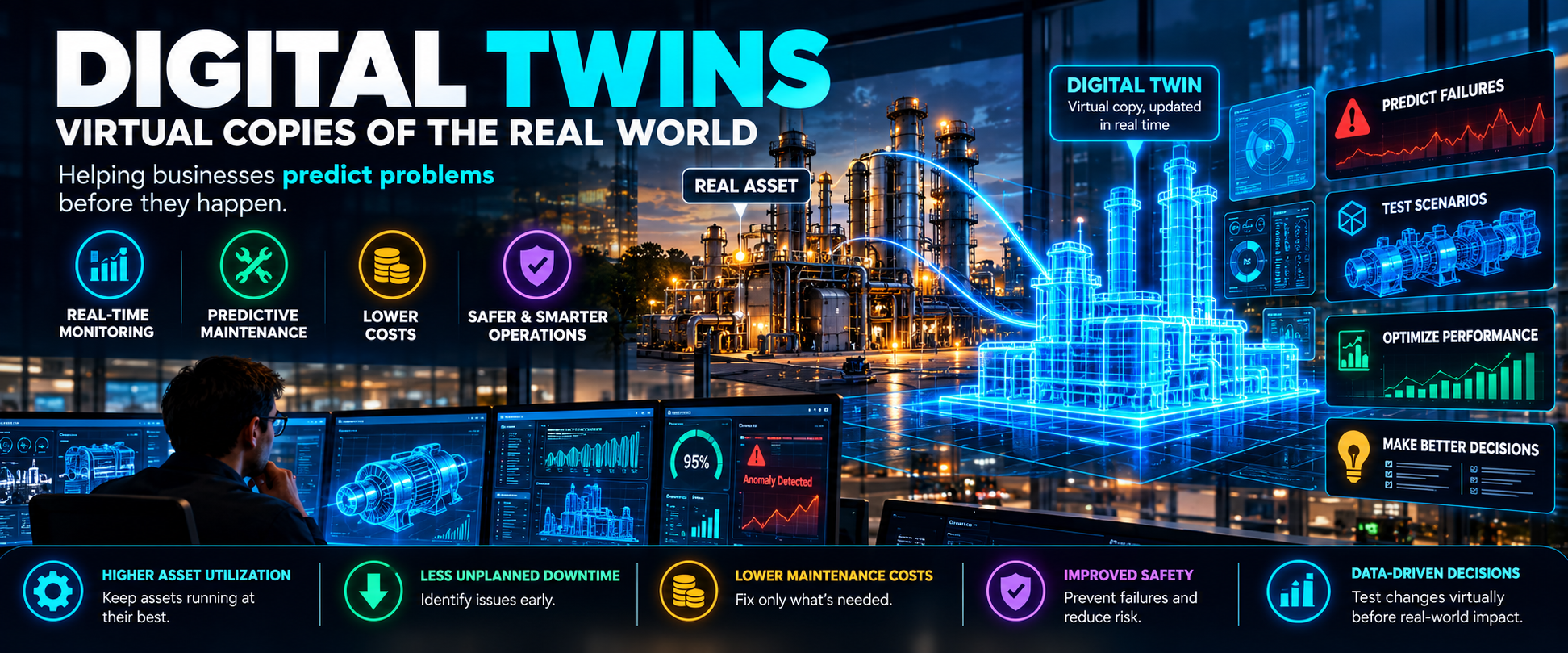
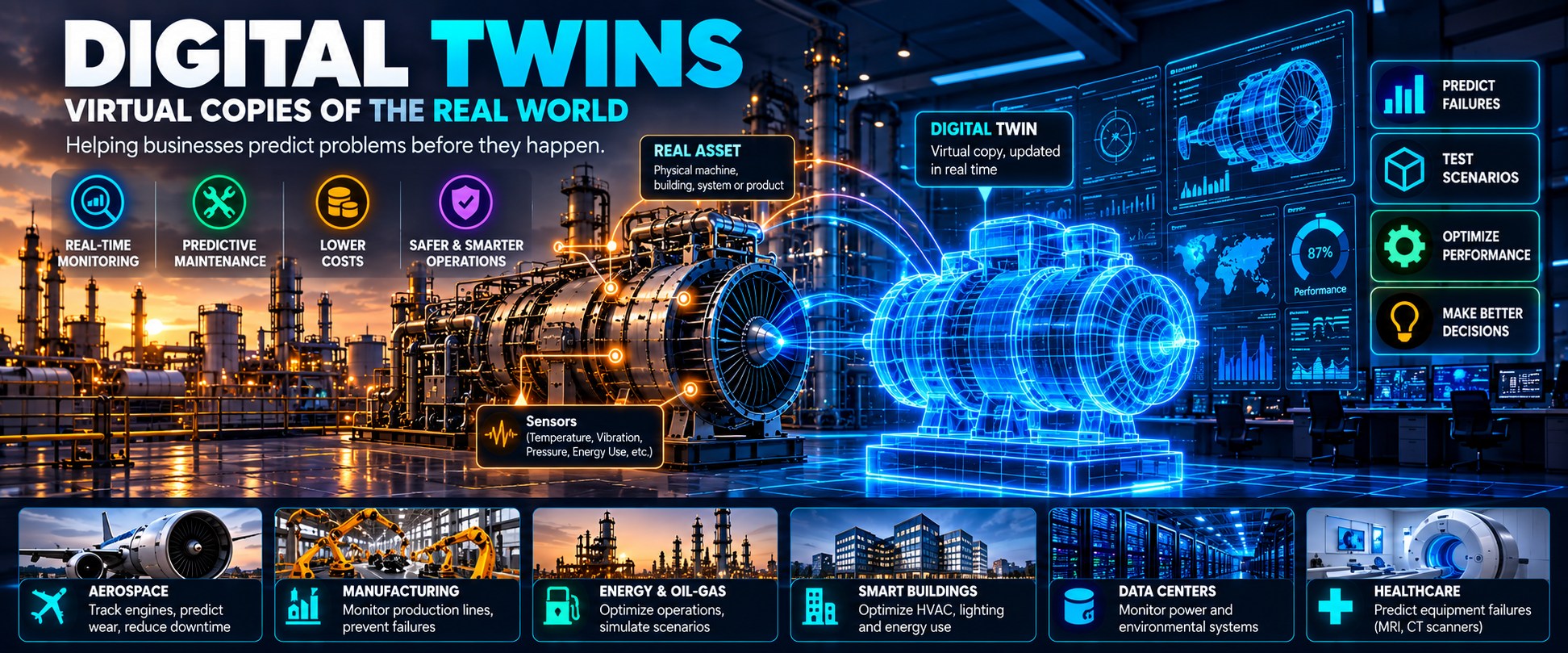
A digital twin is a virtual copy kept in sync with a real asset by live sensor data. The asset can be a single pump, a whole production line, a building, or even a power grid. Sensors on the real thing stream data (temperature, vibration, pressure, energy use, location), and the twin updates to mirror its current condition.

That’s what separates a twin from a plain 3D model or a simulation. A model is static. A twin is alive: it reflects what the physical asset is doing right now, can be asked about its likely future, and can be used to test changes before anyone touches the real equipment.

How it actually works

Most digital twin systems share the same basic loop:

  1. Sense: IoT sensors on the physical asset capture real-time operating data
  2. Connect: that data flows, often through edge devices and the cloud, into the twin
  3. Model: the twin combines the live data with engineering knowledge of how the asset behaves, often enhanced by AI and machine learning
  4. Predict and simulate: the twin flags unusual patterns, estimates remaining useful life, and runs “what if” scenarios
  5. Act: teams (or automated systems) schedule maintenance, adjust settings, or change operations, and the results feed back into the twin

The “predict” step is what delivers the business value. By spotting subtle drift in how a machine behaves, a twin can raise a flag weeks before a failure that would otherwise have arrived as a surprise.

The market has crossed from pilot to infrastructure

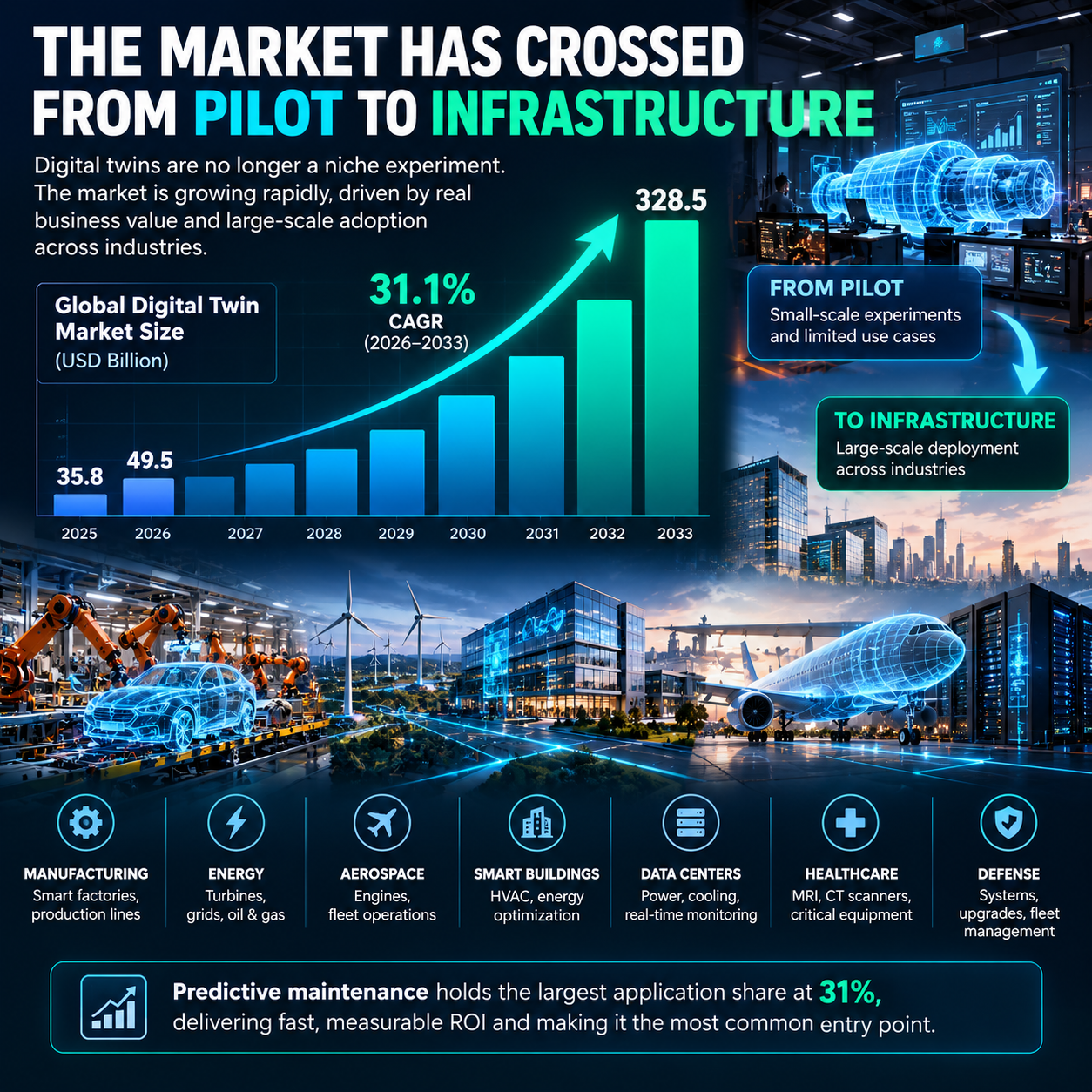
This is no longer a niche experiment. Grand View Research put the global digital twin market at USD 35.8 billion in 2025 and estimates USD 49.5 billion for 2026, forecasting USD 328.5 billion by 2033, a compound annual growth rate of 31.1 percent. And the most common starting point is clear: predictive maintenance holds the largest application share of the digital twin market at 31%, and delivers fast, measurable ROI with a relatively contained implementation scope, which makes it an effective entry point for a first production-grade twin.

Who’s using it, and what they report

Energy and aerospace. Siemens Energy implemented digital twins across its gas turbine operations and reports a 20% reduction in maintenance costs and a 15% improvement in operational efficiency through predictive analytics. Rolls-Royce uses digital twins to track engines during flight, predict wear patterns, recommend maintenance actions, and reduce unnecessary shop visits. Chevron uses them to simulate scenarios and optimize its oil and gas field operations.

Manufacturing. Smart factories use sensor-rich environments to create real-time twins of entire production lines, supporting logistics forecasting, robot path planning, defect inspection, and preventive maintenance. Siemens and NVIDIA, for instance, have partnered on real-time twins of production lines. In food manufacturing, Mars piloted a predictive maintenance program for chocolate production across multiple plants using a digital twin solution running on Microsoft’s Azure IoT Edge platform. BMW’s iFACTORY is also cited as a strong manufacturing example.

Data centers and healthcare equipment. Microsoft deploys digital twin technology across its data centers to monitor critical environmental and power systems in real time, and GE HealthCare applies it to critical imaging equipment such as MRI and CT scanners through its OnWatch Predict solution.

Smart buildings and energy. Twins of commercial buildings integrate data from HVAC, lighting, occupancy, and weather forecasts to continuously tune controls, and UK Green Building Council case studies show AI-enabled optimization delivering electrical energy savings of about 30% and thermal savings of over 40%. Utilities also build twins of transmission and distribution networks to get a live view of grid conditions, power flows, and stress points.

Defense. The F-35 program uses digital twins to manage system upgrades and cut sustainment costs across the fleet.
The numbers, and how to read them

The headline figures are impressive. One analysis reports organizations using digital twins seeing up to 65% less unplanned downtime, 62% better asset utilization, and 79% cost savings through predictive maintenance and real-time simulation. Other industry analyses estimate predictive maintenance enabled by digital twins can cut maintenance costs by around 30% and extend asset life by roughly 20%, and a pharma manufacturer case study reported operating cost reductions of 18 to 28% with payback in under a year.

A fair note on these: they come largely from vendors, consultancies, and selected case studies, and the best-case numbers (65%, 79%) are not what a typical first project should expect. The more modest, named results (Siemens Energy’s 20% maintenance cost reduction, for example) are a more realistic planning anchor.

Where digital twins still struggle

  • Projects stall. A recurring theme in 2026 coverage is why digital twin projects get stuck. The technology works, but data quality, integration with older equipment, and unclear ownership slow things down.
  • Standards are still catching up. Interoperability is being addressed by ISO 23247, but mixing vendors and systems remains harder than it should be.
  • Not every “twin” is a real twin. Some products labeled digital twins are really dashboards or static models without the live sync that defines the concept.
  • Some applications are still aspirational. For example, despite strong interest in personalized medicine, a widely cited industry review notes there are no digital twin applications for actual patients yet. Twins of medical equipment are real; twins of individual human bodies are still largely research.

How a business can start

The pattern among teams getting value is consistent: start narrow. Pick one high-cost, well-instrumented asset where downtime really hurts, prove the prediction works, and expand from there. Predictive maintenance is the common first step because it pays back quickly and keeps the scope contained. Get the sensor data and data quality right first, since a twin is only as good as the data feeding it.

Frequently Asked Questions

What’s the difference between a digital twin and a simulation or 3D model?

A simulation runs on assumed or historical inputs, and a 3D model just shows what something looks like. A digital twin stays connected to a real asset through live sensor data, so it reflects the asset’s condition right now and can predict what happens next. It is a virtual copy kept in sync with a real asset by live sensor data.

Which businesses benefit most from digital twins?

Anyone with expensive physical assets where downtime is costly, such as manufacturers, energy and utility companies, aerospace, data centers, and building operators. Predictive maintenance holds the largest application share of the digital twin market at 31%.

How fast is the payback, and what do you need to get started?

You need live data from the asset (sensors), a reliable way to feed it into a platform, and a model of how the asset behaves. Payback varies, but one pharma manufacturer case study reported operating cost reductions of 18 to 28% and ROI in under a year. Treat that as a best-case example and build your own business case from your actual downtime costs.

Why do some digital twin projects stall, and where should a company start?

The usual causes are poor data quality, trouble connecting older equipment, and trying to model too much at once. The teams that succeed start with the one machine, line, or building that costs them most when it fails, prove the prediction works, then expand.

Key takeaways

  • A digital twin is a virtual copy of a real asset, kept in sync by live sensor data, used to predict problems and test changes safely
  • The market is large and growing quickly, estimated at about USD 49.5 billion in 2026 with a 31.1% projected annual growth rate
  • Predictive maintenance is the dominant use case and the usual entry point, because the payback is clear
  • Named results include Siemens Energy’s 20% maintenance cost reduction, Rolls-Royce’s engine-wear prediction, and building energy savings of 20 to 40%
  • Treat the biggest percentage claims as best-case, vendor-reported figures, and plan around the more modest documented results
  • Common obstacles are data quality, legacy integration, and projects that never move past the pilot stage