Technology

Jev : The AI Model That Doesn't Talk — It Just Decides

Jev : The AI Model That Doesn't Talk — It Just Decides

If you've been anywhere near tech Twitter/X in the last week, you've probably seen people losing their minds over something called "Jev." It racked up tens of millions of views within days of launching, and for good reason: it's a genuinely different kind of AI model. Not a smarter chatbot. Not a faster GPT. Something that doesn't write a single word — and that's precisely the point. In this post, I'll break down what Jev actually is, how it works under the hood, when you'd reach for it instead of ChatGPT or Claude, and how to start experimenting with it yourself. No hype, no jargon dump — just a clear picture of what's going on.

The problem Jev is solving

Here's a scenario every developer has run into. You're building a customer support tool, and you want your code to flag messages from frustrated customers. Easy, right? Just check for angry words.

Except a customer doesn't have to say "I'm frustrated" to be frustrated. They might write: "I've contacted you three times and I'm still waiting." No angry words. Completely obvious to a human that this person is fed up.

You could solve this by sending the message to ChatGPT or Claude and asking it to judge the tone. That works — but it's overkill. You're paying for and waiting on a model that's capable of writing essays, just to get a single yes-or-no judgment back.

That gap — needing a fast, cheap, repeatable judgment rather than a written response — is exactly what a new company called TypeSafe AI built Jev to fill.

So what exactly is Jev?

Jev is an AI model from TypeSafe AI, a San Francisco lab that came out of two years of stealth development on September 15, 2026, with Jev as its first public release. It was built by Diogo Almeida, who worked on the training methods behind ChatGPT and InstructGPT while at OpenAI, alongside co-founders Erik Gafni and Sasha Sheng.

TypeSafe describes Jev as the first "System One" model — a new category of AI that doesn't generate text at all. Instead of writing a reply, it takes a block of state (your data) and returns typed, probabilistic decisions in a single parallel pass, more like a frontier-intelligence function call than a chatbot.

Here's the simplest way to think about it: Jev is a really smart if statement. Ordinary code can branch on things it can calculate — if order.total > 100. It falls apart the moment the condition requires judgment: Is this email a complaint? Does this resume actually show AI experience? Should this transaction be flagged as risky? Jev is built to answer exactly those kinds of questions, instantly and cheaply, so your code can branch on the answer.

Where the names come from, if you're curious: "System One" is a nod to Daniel Kahneman's Thinking, Fast and Slow, which describes two modes of thought — fast, intuitive System 1 judgments, and slow, deliberate System 2 reasoning. TypeSafe borrowed the System 1 half for a model built to make quick judgments inside software. And "Jev" comes from the 19th-century economist William Stanley Jevons, whose paradox observed that when steam engines got more efficient, coal use went up, not down, because cheaper power meant people found more uses for it. TypeSafe is betting the same thing happens with AI: make decisions cheap enough, and people will use AI in far more places than they do today.
How Jev actually works

Every request to Jev has two parts:

  1. State — the information you want it to look at. This can be plain text, a JSON object, or an array. In our frustrated-customer example, the state is just the message itself.
  2. Questions — what you want to know about that state. And this is where it gets interesting, because you don't just ask a free-form question. You pick from three defined answer types: Noul (yes/no) — Jev returns a probability between 0 and 1 that the answer is "yes." Ask "does this message express frustration?" and instead of a flat true/false, you might get back 0.94 — a 94% chance the answer is yes. Choice — you supply a fixed list of options (say: "asking for an update," "requesting a refund," "requesting a replacement," "something else"), and Jev picks one while also returning probabilities for every option. Score — you define a scale with described levels (e.g., "no frustration," "mild dissatisfaction," "strong anger"), and Jev returns a weighted score that can land between levels, plus a confidence value.

You can ask several questions about the same state in one request, and Jev answers all of them independently and in parallel — which is the real trick. A normal language model writes its answer one word at a time, thinking as it goes. Jev skips that entirely and produces every probability at once, which is why it's able to respond in 70 to 500 milliseconds, compared to the several seconds (sometimes much longer) a frontier chat model typically takes for the same kind of reasoning.

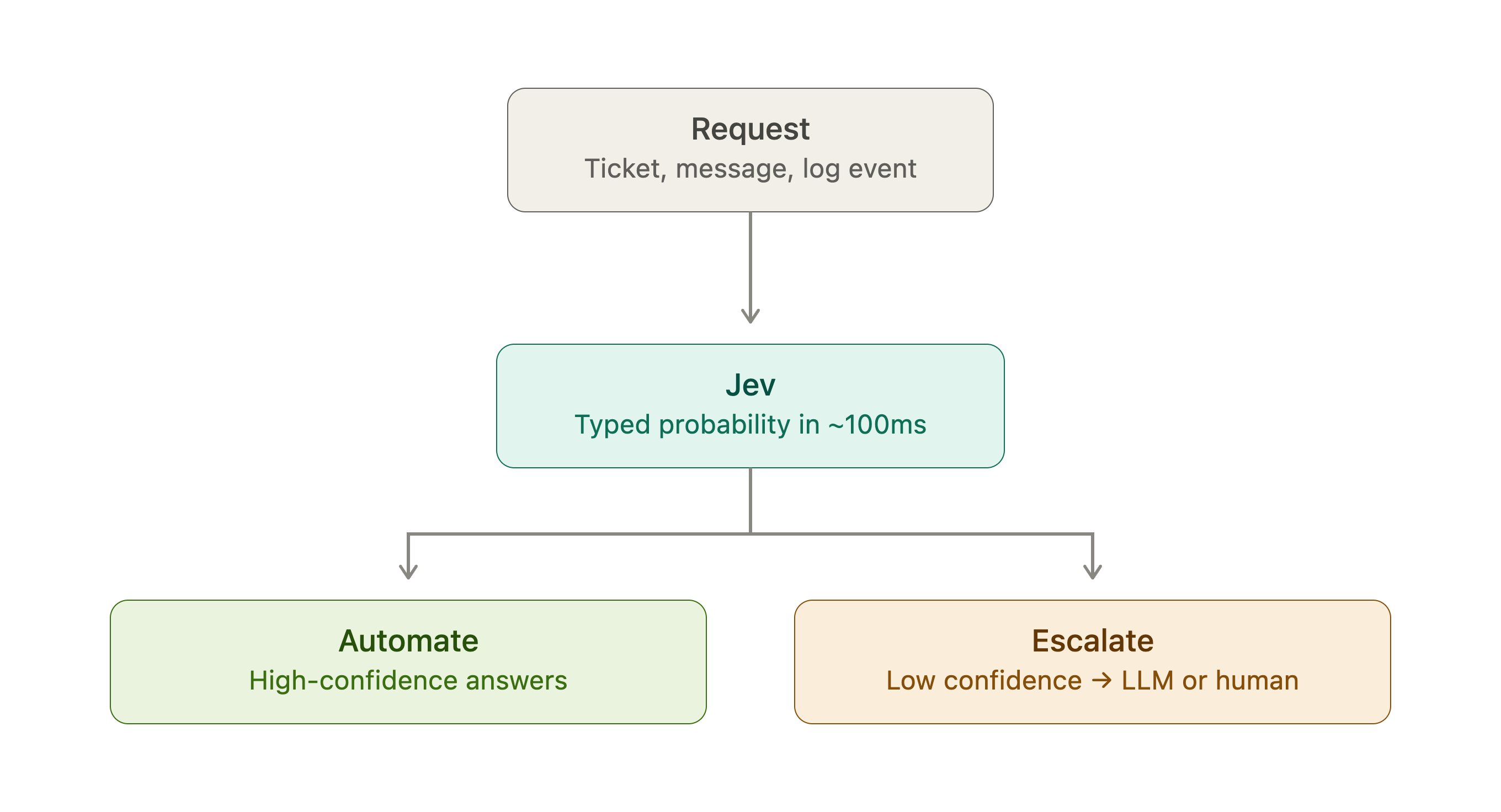
Here's what that decision loop looks like in practice, compared to the traditional way of doing this with a chat-style LLM:

Notice that Jev never generates the reply, the email, or the code — it only produces the judgment. What happens next (auto-approve, route to a queue, kick off a workflow) is ordinary code you write around it.

It's not replacing ChatGPT or Claude — it's their filter

This is the part that trips people up. Is Jev competing with GPT, Claude, or Gemini? No — and TypeSafe isn't trying to make it one. Models like those are excellent at generating things: replies, code, summaries, explanations. Jev generates nothing. It only judges.

Where this gets powerful is in the combination. Picture a support chatbot that has to figure out whether an incoming message belongs to sales, billing, or technical support. Handing that routing decision to a full chat model means the model has to reason through the message, silently "think" about which department fits, and generate that decision as text before your code can even act on it — burning time and tokens on a step that isn't visible to the user at all.

Swap that step for Jev, and the routing decision comes back as a clean set of probabilities — say, 6% billing, 3% technical, 91% sales — in well under a second, for a fraction of a cent. Your code reads the top probability and either routes automatically or, if nothing crosses a confidence threshold, escalates to a person. The heavier chat model only gets involved after routing, when someone actually needs a written response.

The same pattern applies to multi-agent systems, where an AI agent has to first decide which of several tools or sub-agents should handle a task — SQL lookup, web search, a calculator, sending an email — before any actual "thinking" happens. That routing step is a textbook Jev job.

Where people are actually using it

Based on TypeSafe's own use-case list and the early demos flying around online, Jev fits well in:

  • Customer support triage — classifying tickets by intent, urgency, and sentiment before a human or LLM ever reads them
  • Resume and candidate screening — scoring claims in a resume against defined criteria (e.g., "does this candidate show real AI product experience?")
  • Content and ad moderation — flagging policy violations or jailbreak attempts in near real time
  • Agent routing — picking which tool, model, or sub-agent should handle a step in a larger AI workflow
  • Fraud and risk scoring — assigning a probability to a transaction or action before it's approved
  • Guardrails — checking an LLM's output for safety or policy compliance before it reaches a user

The common thread: high-volume, repeated judgments where the possible answers are known in advance, and speed or cost actually matters.

What it costs, and why the pricing model is unusual

Jev is priced at $0.042 per million input tokens — TypeSafe rounds that to $42 per billion — and output tokens are free, since there's essentially nothing to generate. TypeSafe reports this adds up to roughly 40 to 200 times faster and, on its own four-workflow benchmark suite, up to about 193x faster and 445x cheaper than comparable LLM-based approaches.

To put the cost in perspective: at roughly 500 tokens per request (a short message plus a question), $1 covers something in the neighborhood of 47,000 individual decisions. That's the kind of pricing that makes it viable to run a judgment on every incoming message, ticket, or event, instead of sampling a fraction of them.

Two honest caveats worth keeping in mind: these are TypeSafe's own published numbers, not an independent audit, and on their published workflow benchmark Jev lands around 68% accuracy — solidly in the range of mid-tier LLMs, not automatically "smarter." The pitch isn't that Jev is more intelligent. It's that it gets to a comparable judgment dramatically faster and cheaper, which matters enormously when you're calling it thousands of times a day.

Where Jev is the wrong tool

This is honestly the most useful part of understanding any new model — knowing when to leave it alone. Skip Jev when:

  • You need something written. A reply, a summary, an explanation, generated code — anything that needs to come back as prose or code belongs with a normal LLM. Jev can inform that task by judging inputs first, but it won't write the output itself.
  • You can calculate the answer exactly. If a basket has three items, don't ask an AI model whether it has three items. Plain code — comparisons, counting, arithmetic — is faster, free, and infinitely more reliable.
  • The judgment genuinely needs open-ended reasoning. If there's no fixed set of possible answers to define in advance, Jev's structure won't fit the task.

Trying it yourself

Jev is currently in early access. TypeSafe's own console (with a playground and API keys) is gated behind a waitlist, but you don't have to wait for that to experiment — Jev is also available with no waitlist through Vercel's AI Gateway, OpenRouter, and Cloudflare's AI Gateway, all at the same published pricing.

Whichever route you pick, the shape of a request is the same. Here's roughly what a single call looks like using TypeSafe's own SDK style:

import { noul, TypeSafeClient } from "@typesafe-ai/sdk";

if (!process.env.TYPESAFE_API_KEY) {
  console.error("Add your TypeSafe API key to .env before running the demo.");
  process.exit(1);
}

const client = new TypeSafeClient();

const state = {
  message: "I've contacted you three times, and I'm still waiting.",
};

const startedAt = performance.now();
const response = await client.systemOne({
  state,
  questions: {
    isFrustrated: noul("Does `message` express frustration?"),
  },
});
const elapsedMs = performance.now() - startedAt;

console.dir(response, { depth: null });
console.log(`Elapsed: ${elapsedMs.toFixed(0)} ms`);

Key takeaways

  • Jev, from TypeSafe AI, is a new kind of model — a "System One" model — that returns typed, probability-based decisions instead of generated text.
  • It works by taking a block of state plus one or more questions (Noul for yes/no, Choice for picking an option, Score for rating on a scale), and answering them all in parallel, in under half a second.
  • It's dramatically cheaper and faster than using a chat model for the same judgment, but it doesn't replace ChatGPT, Claude, or Gemini — it complements them by handling the routing and classification step before a generative model (or a human) ever gets involved.
  • It's a good fit for high-volume, repeated decisions with a known set of possible answers — support routing, moderation, scoring, agent tool selection — and a bad fit for anything requiring written output or exact calculation.
  • It's brand new (launched September 15, 2026) and still in early access, so treat the more dramatic benchmark numbers as a starting point for your own testing, not gospel.

Next step

if you've got an application that currently sends a full LLM call just to answer a yes/no or multiple-choice question buried inside a bigger workflow, that's your test case. Try swapping that one decision point for a Jev call through one of the no-waitlist gateways and compare the latency and cost yourself — that's the clearest way to see whether the hype holds up for your use case.