
Technology

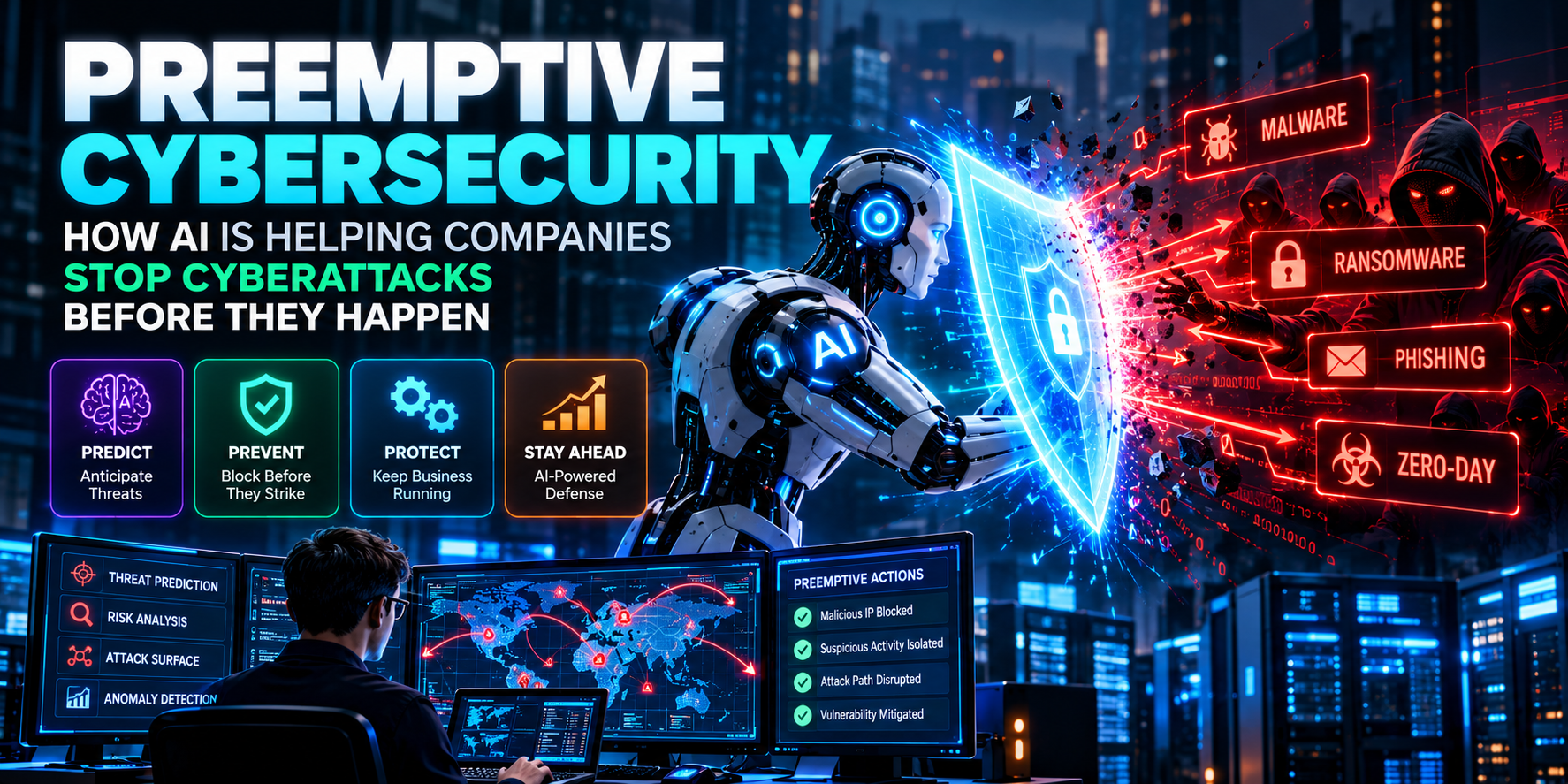
Preemptive Cybersecurity: How AI Is Helping Companies Stop Cyberattacks Before They Happen

Preemptive Cybersecurity: How AI Is Helping Companies Stop Cyberattacks Before They Happen

For twenty years, cybersecurity has mostly meant detecting an attack and responding to it. That model has one built-in weakness: the attacker always moves first. As AI lets attackers work faster and at greater scale, security teams are flipping the script. Instead of reacting to breaches, they’re using AI to predict where attackers will strike and shut the door beforehand. This approach has a name, preemptive cybersecurity, and analysts now rank it among the top technology trends of 2026. Here’s what it means, how it works, and what’s hype versus reality.

The problem: detect-and-respond is always one step behind

Traditional security tools watch for signs of an attack in progress, raise an alert, and wait for a human analyst to investigate. That works when attacks move at human speed. It struggles when they don’t. Gartner warns that AI-enabled attacks will keep growing in speed, scale, and sophistication, and that organizations must shift toward preemptive, autonomous defense to keep up. Google Cloud’s 2026 forecast likewise notes attackers are making AI an integral part of their standard toolkit rather than an experiment.

When an attack unfolds in minutes, a process built on alerts, tickets, and manual investigation is mismatched against it. Defenders need to act before the attack lands, not after.

So what exactly is preemptive cybersecurity?

Gartner defines preemptive cybersecurity as technologies that use advanced AI and machine learning to anticipate and neutralize threats before they materialize. The idea is a shift in timing: from responding to a breach to intercepting the conditions that make it possible.

ApproachCore idea Timing
ReactiveDetect and respond to attacksAfter the damage starts
ProactiveFind and fix weaknesses (patching, scanning)Before, but broad and untargeted
PredictiveForecast likely threats and targetsBefore, and prioritized
Preemptive Act on predictions to block or disrupt the attackBefore the attack lands

Gartner’s research describes it as a shift from broad proactive defense to a targeted, predictive approach that identifies the precursors of an attack and intervenes before a breach occurs.

The market is moving this way, fast

This isn’t a fringe idea. Gartner named preemptive cybersecurity a top strategic technology trend for 2026. And its forecast is bold: by 2030, preemptive solutions are projected to account for half of all security spending, as CIOs shift from reactive defense to proactive protection. That compares with less than 5% in 2024. Gartner also expects preemptive solutions to increasingly replace standalone detection and response tools as the preferred defense.

A fair caveat: that 50% figure is an analyst forecast, not a measured result, and much of the public commentary on the topic comes from vendors selling these products. Treat it as a direction of travel rather than a guarantee.

How AI makes it work

Preemptive security isn’t one product. It’s a set of capabilities that AI makes practical at scale. The main ones named in the industry framing include:

  • Predictive threat intelligence: AI analyzes threat data, attacker behavior, and your own environment to forecast what’s likely to be targeted next, so defenses can be prioritized. Gartner recommends using AI to forecast attacker intent and prioritize defenses.
  • Continuous exposure management: instead of an annual scan, AI continuously maps and validates which weaknesses in your systems an attacker could actually exploit. One vendor, for example, says its AI-driven approach cuts the time to validate its attack surface from weeks to hours.
  • Automated moving target defense: the environment keeps changing (addresses, configurations, paths) so an attacker’s reconnaissance goes stale before they can use it.
  • Deception: decoy systems and fake credentials lure attackers into revealing themselves, turning their own probing against them.
  • Automated denial: “Preemptive cybersecurity is about acting before attackers strike using AI-powered SecOps, programmatic denial and deception,” as Gartner’s Paulman put it. For example, automatically blocking known-bad infrastructure at the network layer before traffic ever reaches an endpoint.

In practice, when AI models identify high-confidence threat patterns, predefined workflows kick off proportionate preventive measures. The words “high-confidence” and “proportionate” matter: a good system acts automatically on clear signals and escalates uncertain ones to a human.

The other half: protecting the AI itself

Companies deploying AI add a new attack surface, and preemptive strategy has to cover it. Gartner pairs this with AI security platforms, which provide a unified way to secure third-party and custom-built AI applications, protecting against risks like prompt injection, data leakage, and rogue agent actions. Gartner predicts that by 2028, more than 50% of enterprises will use AI security platforms to protect their AI investments. Supply chain risk matters here too: a single compromised dependency can cascade across multiple organizations, which is why mapping your code, models, datasets, and third-party components is a recommended first step

Where this can go wrong

  • False positives. Blocking something automatically that turns out to be legitimate can disrupt the business. That’s why confidence thresholds and human escalation paths matter.
  • Prediction isn’t certainty. Forecasts reduce risk; they don’t eliminate it. Reactive detection and incident response are still needed as a backstop.
  • Vendor hype. “Preemptive” is increasingly a marketing label. Ask vendors what, specifically, their product does before an attack, and how that’s measured.
  • Skills and integration. Gartner’s own guidance on this stresses leadership commitment, cross-functional collaboration, and investment in skills. Tools alone won’t deliver it.

How a company can start

  1. Know your assets. You can’t protect what you haven’t mapped: systems, code repositories, AI models, datasets, and third-party components.
  2. Shift budget gradually. Keep detection and response, and add exposure management and predictive intelligence alongside it.
  3. Automate the obvious. Start with high-confidence, low-risk automated actions, such as blocking known malicious infrastructure, and expand as trust builds.
  4. Secure your AI use. Put visibility and guardrails around the AI tools and agents your teams already use.
  5. Measure it. Track whether exposure windows shrink and whether fewer attacks reach production systems.

Frequently Asked Questions

What’s the difference between proactive and preemptive cybersecurity?

Proactive security means finding and fixing weaknesses ahead of time, like patching and vulnerability scanning, but it’s broad and often untargeted. Preemptive security goes further: it uses AI to predict what attackers are likely to do and acts on that prediction to block or disrupt the attack before it lands. It’s described as a targeted, predictive approach that identifies the precursors of an attack and intervenes before a breach occurs.

Does preemptive cybersecurity replace traditional detection and response?

Not entirely, at least not yet. Gartner expects preemptive solutions to increasingly replace standalone detection and response tools as the preferred approach, but detection and response remain an important backstop for the attacks that still get through. Most organizations will layer the two rather than switch overnight.

Can small and mid-sized businesses use it, or is it only for large enterprises?

Many of the underlying capabilities, such as automated blocking of known-bad traffic, continuous exposure scanning, and AI-assisted threat intelligence, are increasingly available as cloud services. Smaller teams can start with asset mapping and automated blocking rather than building everything in-house. Full-scale programs with deception and moving target defense are more common in large enterprises today.

What are the biggest risks of letting AI act automatically on security decisions?

The main risks are false positives that block legitimate activity, over-reliance on predictions that can be wrong, and attackers learning to game the system. The usual safeguards are confidence thresholds, proportionate actions, human escalation for uncertain cases, and keeping detection and response in place.

Key takeaways

  • Detect-and-respond is always one step behind, and AI-accelerated attacks make that gap more dangerous
  • Preemptive cybersecurity uses AI to anticipate and neutralize threats before they materialize, shifting the timing of defense from after the breach to before it
  • Gartner ranks it a top 2026 trend and forecasts it will reach half of security spending by 2030, up from under 5% in 2024, though that’s a forecast and much commentary comes from vendors
  • Core capabilities include predictive threat intelligence, continuous exposure management, moving target defense, deception, and automated denial
  • Securing your own AI tools and supply chain is part of the strategy, not an add-on
  • Start by mapping assets and automating high-confidence actions, and keep reactive tools as a backstop