Technology

Satellite Internet Revolution: Bringing High-Speed Connectivity to the World’s Most Remote Regions

Satellite Internet Revolution: Bringing High-Speed Connectivity to the World’s Most Remote Regions

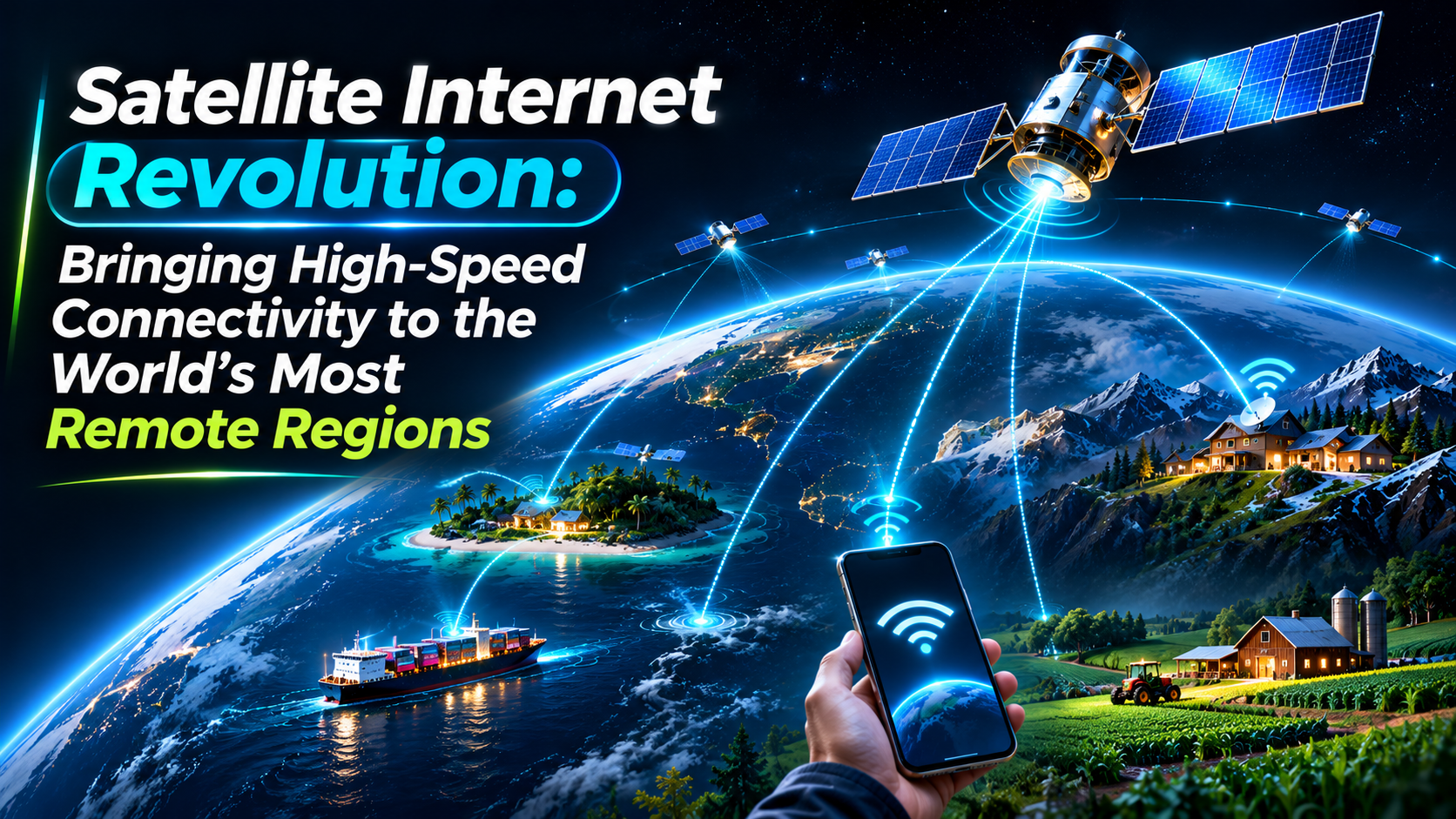
For most of the internet’s history, getting online meant being near a cable or a cell tower. If you lived on a mountain, an island, a desert, or a village far from the nearest fibre line, you were simply out of luck. A new generation of satellites is changing that. Thousands of small spacecraft orbiting close to Earth now beam broadband to dishes the size of a pizza box, and in some cases straight to ordinary phones. This article explains how it works, who is building it, what it’s already doing, and what still stands in the way.

The problem: billions are still offline

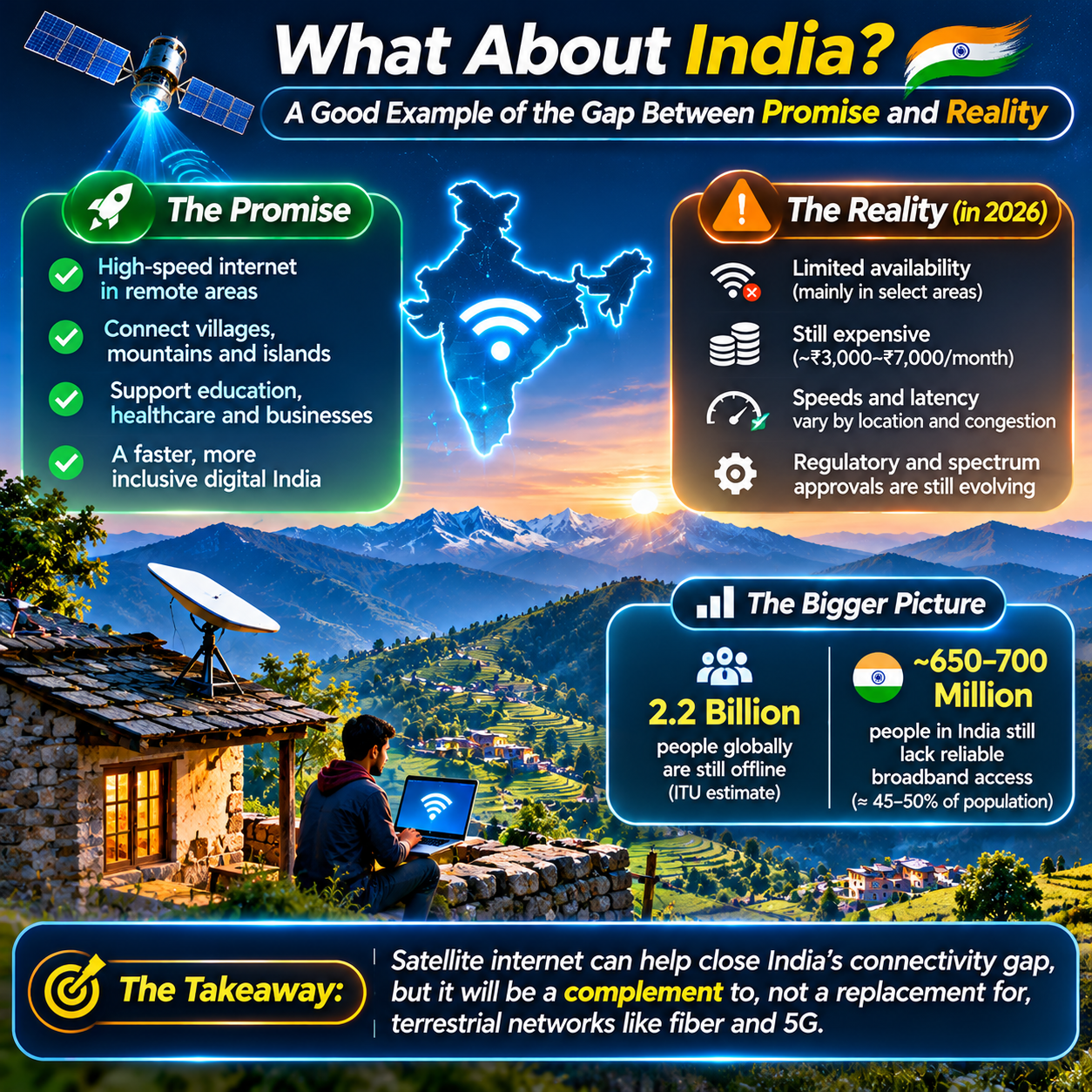
Terrestrial networks are brilliant where people are packed together and uneconomic where they are not. Laying fibre across forests, mountains and thinly populated land costs a great deal for very few customers, and mobile towers need power, roads and maintenance crews. The result is a persistent gap. One 2026 statistics roundup cites an ITU estimate of 2.2 billion people who remain offline. The figure is an estimate, and not everyone offline lacks coverage; cost, devices and skills matter too. But geography is a large part of the story.

Older satellite internet existed, but it had a bad reputation: slow, laggy and expensive. To understand what changed, you need to understand orbits.
What changed: from far-away satellites to a swarm in low orbit

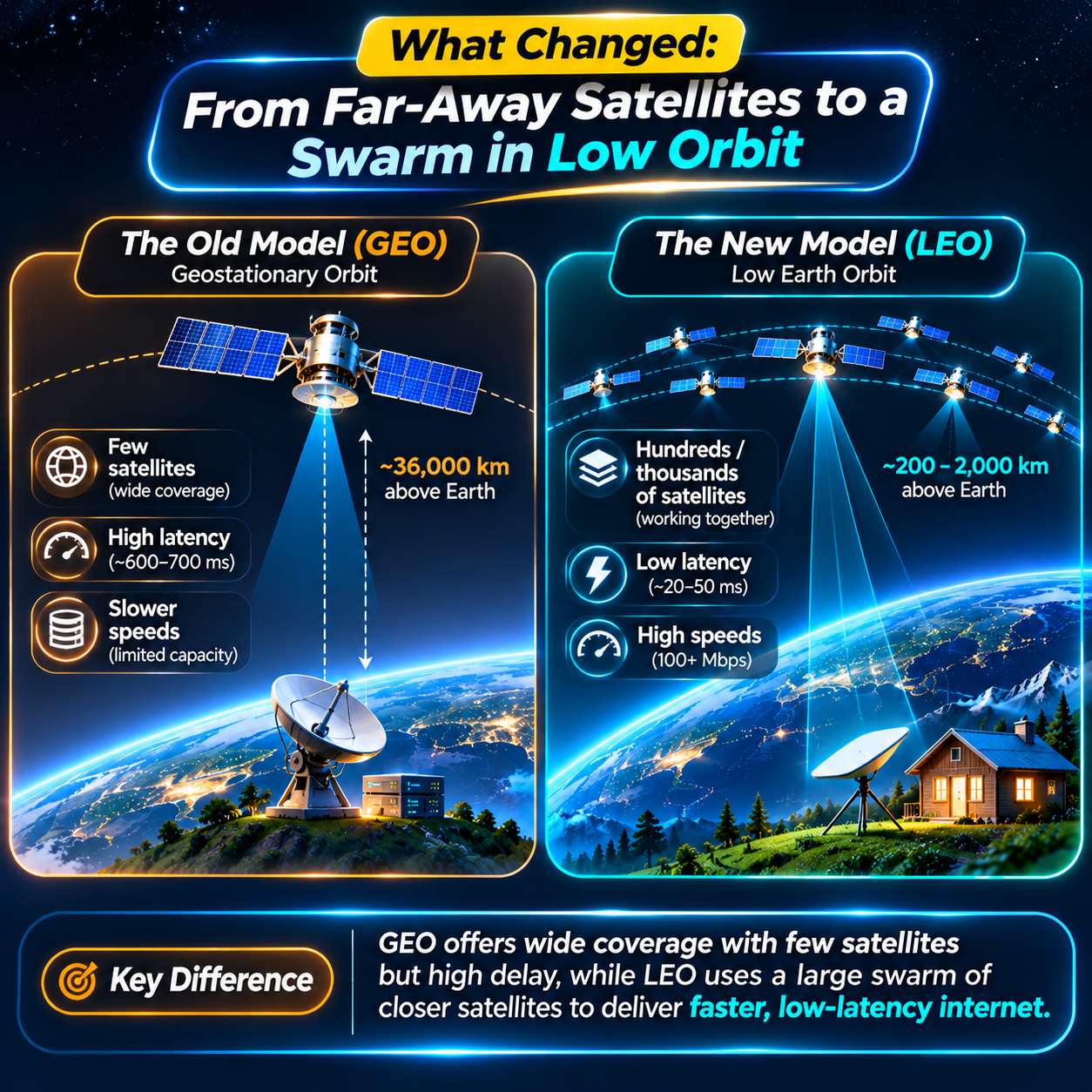
The old model (GEO). Traditional internet satellites sit in geostationary orbit, roughly 36,000 km above the equator. They hover over one spot, so a few satellites can cover a huge area. But the distance means signals take a long time to travel up and back, which gives the delay that made video calls, gaming and fast web browsing painful.

The new model (LEO). Low Earth Orbit satellites fly only a few hundred kilometres up, so signals have a far shorter trip. The trade-off is that each satellite passes overhead quickly, so you need hundreds or thousands of them working together, handing users off from one to the next, like a constantly moving mesh of relay stations.

This is why the latency numbers look so different now. Starlink’s reported median latency is about 25 ms, with a median download of 225 Mbps in peak hours for residential users (as of 31 March 2026). Those are delivered figures reported by one comparison, and individual experience will vary with location, congestion and weather, but they are in a completely different league from legacy GEO service.

Who is building it

Starlink (SpaceX) is the clear leader. One comparison says it has 11,102 satellites in orbit and 12.0 million subscribers in 167 countries, territories and other markets on 30 June 2026, up from 6 million a year earlier according to another review. Another count puts the company at about 9,600 of the 10,622 known active LEO internet satellites across Starlink, Eutelsat OneWeb and Amazon Leo. Numbers differ by date and method, but the scale is not in doubt: Starlink dominates the sky.

Amazon Leo (formerly Project Kuiper) is the main challenger. It has roughly 391 satellites in orbit against a planned first phase of 3,236 authorized by the FCC, and as of mid-2026 it is not yet publicly available for residential customers. Its early focus is enterprise, government and cloud-connected customers.

Eutelsat OneWeb takes a different route, selling mainly to businesses, governments and telecom operators rather than directly to households. One estimate puts its constellation at 647 satellites, and it is positioned as the enterprise play.

Others include national and regional projects, and established GEO operators such as Viasat that are adapting. The race is increasingly geopolitical as well as commercial.

What it’s already doing in remote places

The most compelling stories are practical rather than futuristic:

  • Rural homes and farms. Families and agricultural businesses that previously relied on weak mobile signals or nothing at all can get broadband for video calls, online learning, banking and remote work. Farmers can use connected sensors, machinery and market data.
  • Schools and clinics. A remote school with a satellite terminal can use online lessons and digital resources. A village clinic can consult specialists by video and send medical images, and keep records in cloud systems.
  • Disaster response. When storms, earthquakes or floods destroy ground infrastructure, a satellite terminal can restore communications within minutes. Emergency teams and aid agencies increasingly carry them.
  • Ships, planes and expeditions. Maritime and aviation connectivity has been transformed, giving crews and passengers connections that used to be extremely expensive or unreliable. The same applies to research stations, mining sites, oil rigs and expeditions.
  • Backup and resilience. Even in well-connected places, businesses use satellite links as a backup path when fibre fails.

The next leap: satellites talking directly to phones

The dish-on-the-roof model solves a lot, but a second idea may matter even more: connecting ordinary smartphones directly to satellites, with no special hardware. This is called direct-to-cell or direct-to-device.

It has moved quickly from announcement to reality. One 2026 review says direct-to-cell went from an announcement to a live service used across 22 countries. Industry deals are also reshaping the field: one report notes that SpaceX bulked up Starlink Direct to Cell with a $17B EchoStar spectrum deal.

For now, direct-to-phone service is mostly suited to texting, basic messaging and emergency use rather than full broadband, because a phone’s small antenna and low power limit the data rate. But even basic coverage in places with no mobile signal is a big step for safety, hiking, remote work and emergencies. It is also closely tied to the 6G vision of blending towers and satellites into one network, which we covered in our article on 6G.

What about India? A good example of the gap between promise and reality

The most recent reporting shows that approvals and actual service are two different things. One analysis states that nobody in India can buy satellite broadband from Starlink, Jio or Eutelsat OneWeb as of 11 November 2026, and what is missing is commercial spectrum, not a licence. Another summary says that as of October 2026, Starlink, Eutelsat OneWeb and Jio-SES hold licences, but commercial launch still depends on security clearance and spectrum assignment.

There has been progress and friction. One review says India froze further approvals in mid-2026 over security concerns about terminal use during the Iran war, and that on 9 September the Digital Communications Commission approved most of the telecom regulator’s recommendations on satellite spectrum pricing, a step described as bringing commercial launch “nearer” rather than confirming it. A separate summary says the pricing approved is a revenue charge of 5 per cent of AGR, falling to 4 per cent in rural and remote areas. Meanwhile, Amazon’s Indian application was still under examination in the DoT’s January 2026 update.

The lesson is broader than India. Satellite internet runs into national rules on spectrum, licensing, security and data, and each country decides on its own timeline.

The challenges nobody should skip

  1. Step 1: Cost.

    The hardware and monthly plans are often out of reach for the very communities that would benefit most. Prices differ widely by country and plan, and published figures vary across sources, so check local pricing rather than relying on headline numbers. Subsidies, community terminals and shared access may be necessary to turn coverage into real inclusion.

  2. Step 2: Capacity and congestion.

    A satellite beam can serve only so many users. As more people sign up in an area, performance can drop. This matters most in places where demand is dense.

  3. Step 3: Dependence on one provider.

    A single company has by far the largest share of satellites. That concentration is a risk for governments and businesses relying on it, which is why alternatives such as Amazon Leo, OneWeb and regional systems matter.

  4. Step 4: Space sustainability.

    Tens of thousands of satellites raise concerns about orbital debris, collision risk, light pollution for astronomers and atmospheric effects when satellites reach end of life. Operators and regulators are working on rules, but this is an unresolved global issue.

  5. Step 5: Regulation and geopolitics.

    As the India example shows, spectrum, security reviews and national control over communications can delay or limit service. Connectivity from space also raises questions about who controls access during conflicts.

  6. Step 6: Weather and obstructions.

    Heavy rain, snow and physical obstructions like trees or buildings can affect performance, and terminals need a clear view of the sky.

  7. Step 7: Local ecosystems.

    Satellite links need local devices, power, skills and support. A school that gets a terminal but has no reliable electricity, computers or trained staff will not see the full benefit.

Satellite internet versus fibre and mobile: where each fits

FibreMobile (4G/5G)LEO satellite
Best forDense towns and citiesAnywhere with towersRemote, rural, maritime, disaster zones
Speed and latencyExcellentVery good where coveredGood; far better than old GEO
Cost to extend to remote areasVery highHighLower infrastructure cost, but pricey for the user
WeaknessesSlow, costly rolloutCoverage gapsCapacity limits, cost, regulation
Role in futureBackboneMainstream accessComplement that fills the gaps

The sensible way to think about it is as a complement, not a replacement. Satellite fills the gaps where other networks do not reach, and acts as backup everywhere else.

What this means for businesses and developers

  • Design for variable networks. Applications may run over links with different latency and occasional handovers, so build in retries, caching and graceful degradation.
  • Rethink remote operations. Mining, agriculture, logistics, energy and field services can use satellite links for monitoring, telemetry and real-time systems.
  • Plan resilience. A satellite link as a secondary path can protect critical operations from fibre cuts and local outages.
  • Mind data and compliance. Understand where traffic is routed and what local regulations apply, especially for sensitive data.
  • Watch the market. More competitors, direct-to-phone services and new regulation will change prices and options over the next few years.

Frequently Asked Questions

How is today’s satellite internet different from the old kind?

Older systems used satellites about 36,000 km up, which caused long delays. Newer low-Earth-orbit constellations fly just a few hundred kilometres up, so signals travel much less distance. That gives far lower latency and much higher speeds, though it needs thousands of satellites working together.

Can satellite internet really replace fibre or mobile?

Not in most places. It is best seen as a complement that covers remote areas, ships, aircraft and emergencies, and as a backup elsewhere. Fibre and mobile networks are still more efficient and cheaper in dense areas.

Is satellite internet available in India?

Not for commercial sale as of mid-November 2026, according to recent reporting. Companies including Starlink, Jio and Eutelsat OneWeb hold licences, but launch depends on spectrum assignment and security clearances. Regulatory steps in September moved the process forward without confirming a launch date, so check the latest official announcements.

Can my normal phone connect to a satellite?

In some countries, yes, through direct-to-cell services that work with compatible phones, mainly for texting and emergencies rather than full broadband. Availability depends on your mobile operator, device and country.

Key takeaways

  • Low-Earth-orbit satellites, flying just a few hundred kilometres up, have fixed the lag problem that made older satellite internet unattractive
  • Starlink leads by a wide margin, with roughly 12 million subscribers reported at the end of June 2026, while Amazon Leo and OneWeb are building out more slowly
  • Real-world benefits are strongest in remote homes, schools, clinics, shipping, aviation, disaster response and backup connectivity
  • Direct-to-cell services are now live in some countries, offering basic coverage to ordinary phones, though not yet full broadband
  • The biggest obstacles are cost, capacity, dependence on a single provider, regulation and space sustainability, not just technology
  • India shows how licences alone are not enough: spectrum and security clearances decide when service actually starts
  • Satellite works best as a complement to fibre and mobile networks, filling the gaps rather than replacing them