Technology

What Is Generative AI and How Does It Work? The Complete Modern Guide

What Is Generative AI and How Does It Work? The Complete Modern Guide

An authoritative, in-depth guide explaining what Generative AI is, how it works under the hood, and how it differs from traditional machine learning. Explore the revolutionary mechanics of Transformers, Self-Attention, Latent Diffusion, the 4-stage training pipeline, real-world industry applications, and key ethical guardrails.

Introduction: The Dawn of the Generative Era

For the first seventy years of computer science, machines were essentially passive calculators and rigid rule-followers. You gave a software program a precise set of instructions—an algorithm—and it executed those instructions with flawless mathematical precision. When artificial intelligence took its first commercial leaps in the 2010s, it was largely analytical: systems could tell you if a credit card transaction was fraudulent, recommend a song you might like, or tag your friend in a photograph.

Yet, as impressive as those capabilities were, computers remained fundamentally incapable of the one trait humanity considered uniquely its own: original creation. A computer could calculate the trajectory of a rocket to Mars, but it could not write an original sonnet about the journey, compose an emotive orchestral score, or paint an ethereal Martian landscape from scratch.

That historical barrier has now permanently collapsed.

We have entered the era of Generative Artificial Intelligence—widely known as Generative AI or GenAI. Today, neural networks can draft comprehensive legal contracts, synthesize photorealistic cinematic videos from a single sentence, generate production-ready software architectures, and converse with human-level nuance across hundreds of languages.

To understand this technological revolution is not just an academic exercise; it is the essential literacy of the modern digital age. In this comprehensive guide, we will unpack what Generative AI truly is, demystify the mathematical engines that power it, and explore how it is reshaping the architecture of human work.
What Exactly Is Generative AI? The Critic vs. The Creator

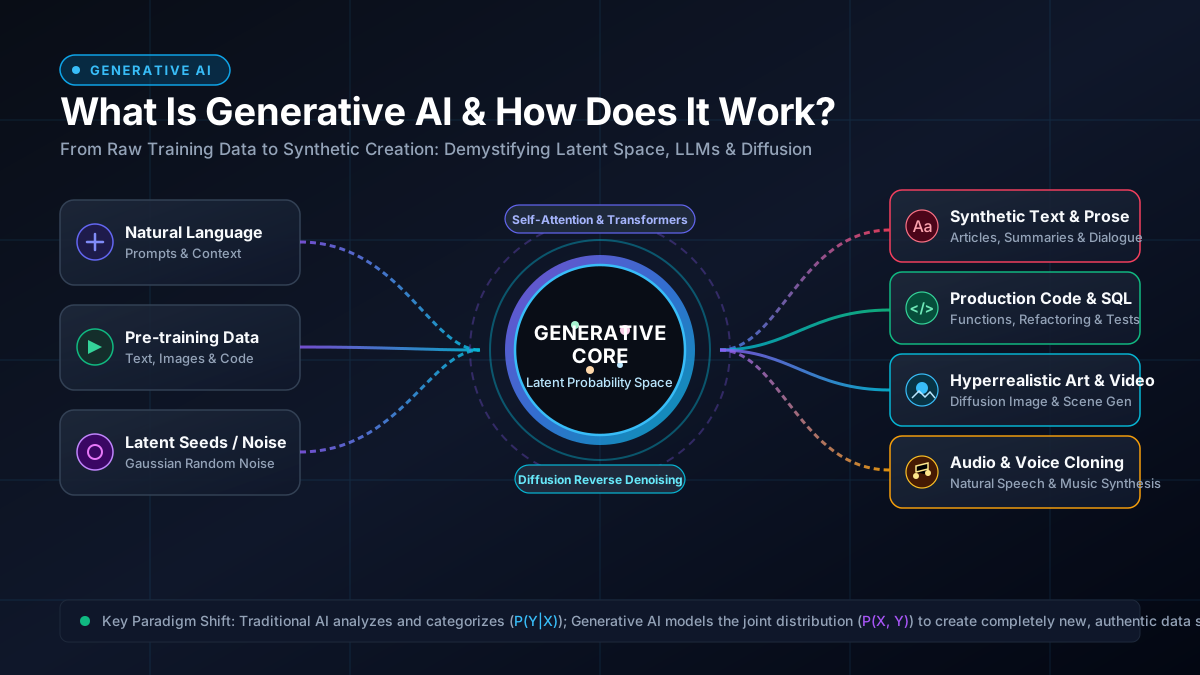
At its most fundamental definition, Generative Artificial Intelligence refers to a category of deep learning models capable of synthesizing completely new, authentic-looking digital artifacts—such as text, images, computer code, audio, 3D assets, and synthetic data—that mirror the structural complexity and nuance of human-created content.

To appreciate why this is such a profound evolutionary leap, it helps to understand the difference between traditional Artificial Intelligence and Generative AI through the analogy of the Michelin Food Critic versus the Master Executive Chef.

Traditional machine learning is the Food Critic. If you place a gourmet dish in front of the critic, they can analyze the flavors, identify the ingredients, determine whether the steak is cooked rare or medium-well, and assign the plate a rating from one to five stars. Mathematically, the critic evaluates existing data and classifies it into predefined categories.

Generative AI, on the other hand, is the Master Executive Chef. The chef does not merely inspect or rate existing plates. The chef has spent decades studying flavor combinations, culinary techniques, and cultural traditions. When given a request—such as "Invent a refreshing Mediterranean summer appetizer that incorporates smoked rosemary and citrus"—the chef steps into the kitchen and synthesizes an entirely new recipe from scratch that has never existed before, yet tastes extraordinary.

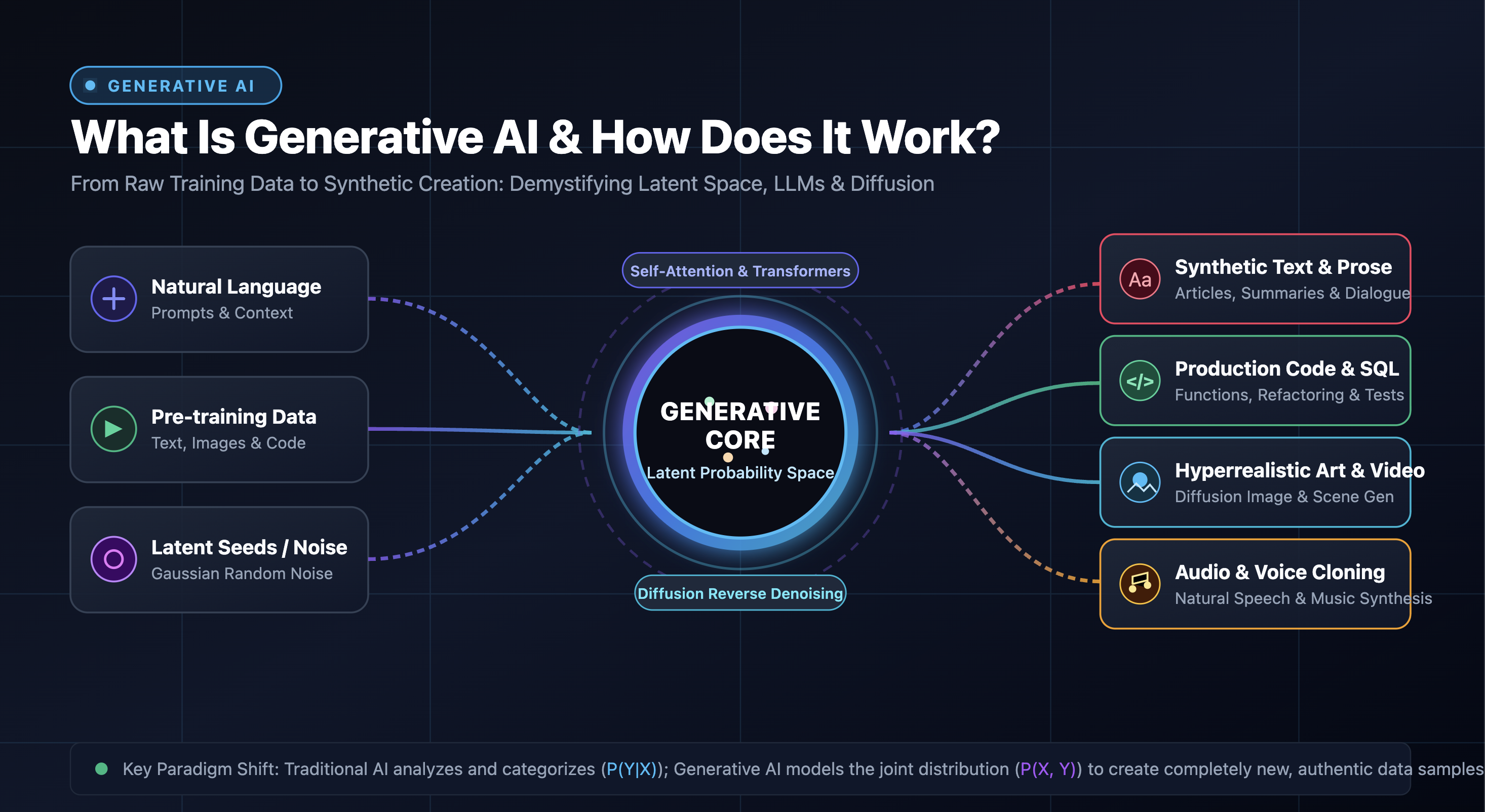
In mathematical terms, traditional AI models the conditional probability of a label given an input, represented as P(Y|X). Generative AI models the underlying joint probability distribution of the data universe itself, represented as P(X) or P(X, Y). Because the generative model understands the deep statistical geometry of how words, pixels, or notes relate to one another, it can sample from that high-dimensional mathematical space to produce brand-new instances that are coherent, contextually relevant, and remarkably creative.

Title: The Four Core Synthesis Capabilities of Modern Generative AI

Generative AI is not a single, narrow algorithm. Rather, it represents an umbrella ecosystem of multi-modal architectures spanning four primary creative domains:

  1. Natural Language & Text Generation: Large Language Models (LLMs) synthesize fluent prose, executive summaries, technical documentation, creative fiction, conversational dialogues, and multi-language translations.
  2. Computer Vision & Visual Synthesis: Diffusion models and neural rendering engines produce high-resolution photorealistic imagery, digital paintings, brand graphics, vector art, visual effects, and full-motion cinematic video.
  3. Software Engineering & Logic Architecture: Specialized code models generate functional source code across dozens of programming languages, synthesize unit tests, translate legacy codebases, write complex SQL queries, and diagnose security vulnerabilities.
  4. Audio, Voice & Scientific Modeling: Generative neural audio synthesizes natural human speech with emotional inflection, composes full musical tracks, and in scientific domains, designs de novo protein structures, molecular drug candidates, and synthetic medical datasets.

Discriminative AI vs. Generative AI: The Architectural Comparison

Feature Discriminative AI (Traditional Machine Learning) Generative AI (Modern Deep Learning)
Mathematical Objective Estimates conditional probability P(Y | X) to map inputs to specific predefined labels Estimates joint probability distribution P(X) or P(X, Y) to model how data is distributed
Primary Function Analyzes, filters, classifies, detects anomalies, and predicts numerical values Synthesizes, composes, invents, designs, and refactors brand-new content
Output Modality Discrete categorical labels, confidence scores, bounding boxes, or regression values Coherent long-form text, high-resolution images, full-motion video, source code, or audio
Training Paradigm Heavily dependent on supervised learning with millions of human-labeled data points Self-supervised pre-training on petabytes of unstructured data, followed by alignment
Intuitive Real-World Analogy The Inspector / The Food Critic who verifies, grades, and categorizes existing items The Executive Chef / The Artist who designs, invents, and cooks original creations
Representative Models ResNet, Support Vector Machines (SVM), Random Forests, XGBoost, Logistic Regression GPT-4, Claude, Gemini, LLaMA, Stable Diffusion, Midjourney, Sora, Whisper

The Architectural Engine: How Transformers Revolutionized Artificial Intelligence

To understand how modern Generative AI works under the hood, we must trace back to a watershed moment in computer science history: the publication of the seminal 2017 research paper by Google researchers entitled "Attention Is All You Need."

Before 2017, natural language processing relied primarily on Recurrent Neural Networks (RNNs) and Long Short-Term Memory networks (LSTMs). These earlier architectures processed text sequentially, word by word, from left to right—much like a human reading a sentence through a tiny peephole.

This sequential approach suffered from two fatal engineering bottlenecks. First, it was practically impossible to parallelize across modern GPU clusters because word number fifty could not be calculated until word number forty-nine had finished processing. Second, they suffered from catastrophic forgetting: by the time an RNN reached the end of a long paragraph, the mathematical signal from the opening sentence had decayed into insignificance.

The Transformer architecture obliterated both bottlenecks in one stroke.

Instead of processing words sequentially, Transformers ingest entire documents simultaneously in parallel. To make sense of this simultaneous flood of information, the Transformer employs a revolutionary mathematical mechanism called Multi-Head Self-Attention.

Demystifying Self-Attention: How Neural Networks Understand Context

In human language, words do not possess static, isolated meanings; their meaning is dynamically shaped by the words that surround them. Consider the word "bank" in these two distinct sentences:

Sentence A: "He sat by the river bank and watched the water flow."

Sentence B: "The bank approved the commercial real estate loan."

A primitive computer dictionary sees the exact same four letters: B-A-N-K. But a human instantly recognizes that in Sentence A, "bank" refers to sloping geological terrain, while in Sentence B, it refers to a regulated financial depository.

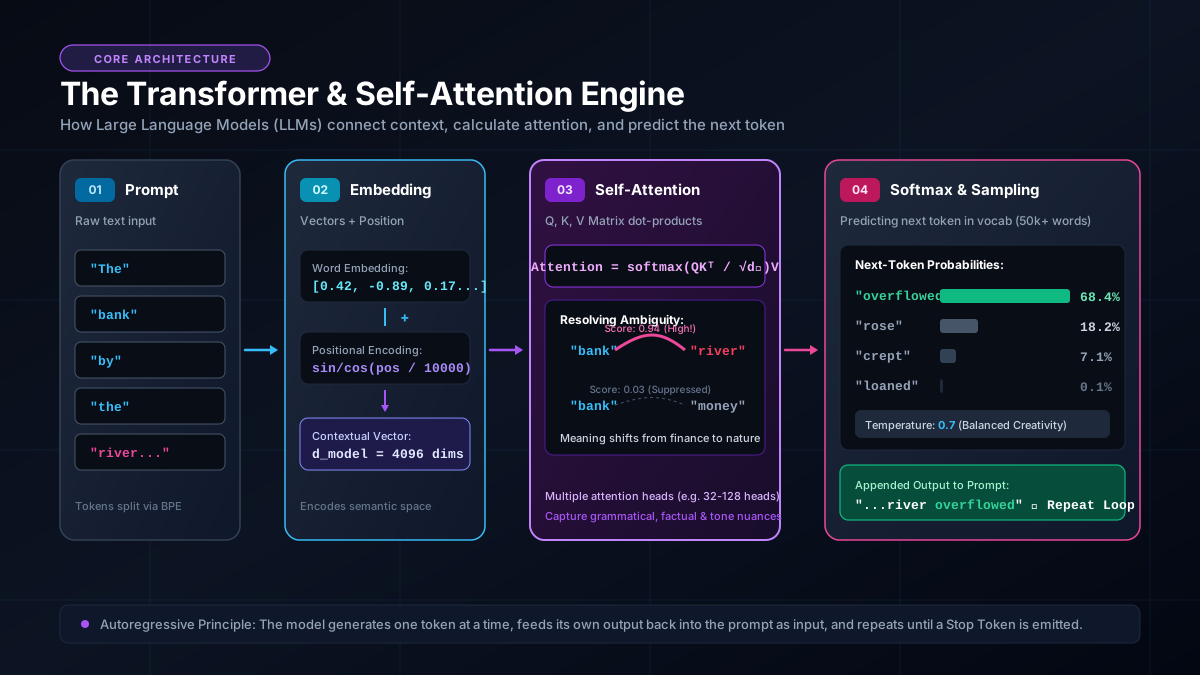
How does a Transformer resolve this ambiguity? Through the mechanics of Self-Attention, which executes across three distinct mathematical stages

  • Projecting Query, Key, and Value Vectors (Q, K, V): For every single token in the input prompt, the model generates three separate high-dimensional mathematical vectors: a Query (representing what this token is searching for), a Key (representing what this token contains), and a Value (representing the actual semantic information of the token).
  • Calculating Dot-Product Attention Scores: The model takes the Query vector of the target word ("bank") and calculates the mathematical dot-product against the Key vectors of every other word in the sequence. Words with high contextual relevance—like "river" and "water"—produce a massive attention score, while irrelevant words produce a score near zero.
  • Softmax Normalization & Contextual Synthesis: These raw scores are passed through a Softmax function to convert them into a normalized probability distribution that sums to 1.0. The model then computes a weighted sum of the Value vectors. The resulting contextual representation of "bank" is dynamically infused with the aquatic meaning of "river."

Under the Hood: How Autoregressive Text Sampling Works in Python

import numpy as np

def sample_next_token(logits: np.ndarray, temperature: float = 0.7) -> int:
    """
    Demonstrates how Generative LLMs convert raw neural network predictions (logits)
    into a creative probability distribution and sample the next token.
    
    Args:
        logits: Raw unbounded numerical scores for each word in vocabulary (e.g., 50,000 words).
        temperature: Controls randomness. 
                     Lower (<0.5) = focused, deterministic, conservative.
                     Higher (>1.0) = creative, diverse, unexpected.
    Returns:
        The integer index of the selected token.
    """
    # 1. Apply Temperature Scaling: Adjust the sharpness of the distribution
    scaled_logits = logits / max(temperature, 1e-5)
    
    # 2. Subtract max for numerical stability (prevent exponential overflow)
    stable_logits = scaled_logits - np.max(scaled_logits)
    
    # 3. Softmax Function: Convert unbounded logits into probabilities summing to 1.0
    probabilities = np.exp(stable_logits) / np.sum(np.exp(stable_logits))
    
    # 4. Probabilistic Sampling: Pick the next token according to the probability curve
    token_index = np.random.choice(len(probabilities), p=probabilities)
    return token_index

# Example: Vocabulary of 4 candidate words after prompt "The river..."
vocab = ["overflowed", "rose", "crept", "loaned"]
raw_scores = np.array([5.2, 3.8, 2.1, -1.5])

# Low Temperature (Strict logic, picks highest probability almost every time)
print("Greedy/Low Temp (0.2):", vocab[sample_next_token(raw_scores, temperature=0.2)])

# Balanced Temperature (Standard creative writing)
print("Balanced Temp (0.7):", vocab[sample_next_token(raw_scores, temperature=0.7)])

From Static Noise to Masterpieces: How Diffusion Models Work

While Large Language Models operate on discrete symbolic tokens like words and punctuation, generative models for images and video—such as Midjourney, Stable Diffusion, and DALL-E—operate in the continuous domain of pixels and light.

To generate breathtaking imagery from simple natural language prompts, computer vision researchers took inspiration from a surprising branch of physics: non-equilibrium thermodynamics.

The resulting architecture is known as a Diffusion Model.

To understand diffusion intuitively, imagine an ancient sculptor standing before a massive, rough block of marble. The marble looks completely chaotic and uniform from the outside. But inside that stone, the sculptor envisions the statue of David. Chisel stroke by chisel stroke, the sculptor systematically chips away unwanted rock, gradually revealing the refined contours, limbs, and facial features beneath.

A Diffusion Model is the digital equivalent of that sculptor, and the block of marble is pure random mathematical noise.

The Two Mirrored Cycles of Diffusion Architecture

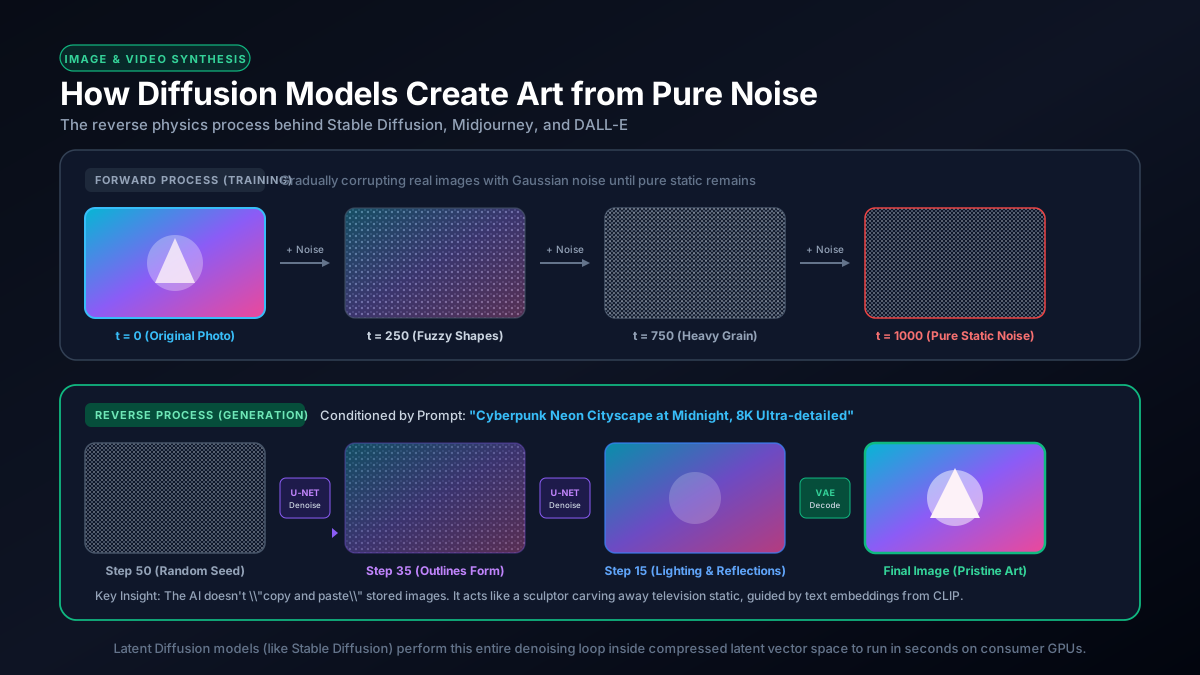
Diffusion models do not "copy and paste" pieces of photographs from a secret database. Instead, their magic relies on mastering two symmetrical processes:

  1. The Forward Process (Noise Injection): During the training phase, researchers take millions of high-resolution photographs. Over a sequence of discrete timesteps (typically 1,000 steps), the model mathematically injects tiny amounts of Gaussian random noise into each image. By step 1,000, all recognizable shapes, edges, and colors are completely destroyed, leaving behind a screen of pure, chaotic television static.
  2. The Reverse Process (Conditioned Denoising): The true breakthrough happens here. A specialized neural network (usually a U-Net or a modern Diffusion Transformer) is trained to look at a noisy image at step T and accurately predict the exact noise that was added. By subtracting that predicted noise, it steps backward toward clarity. When guided by text embeddings from a model like CLIP ("A cyberpunk neon city reflected in rain puddles at midnight"), the neural network iteratively steers the denoising process, coaxing vibrant skyscrapers, neon signs, and water reflections out of absolute vacuum.

The Engineering Journey: The 4-Stage Generative AI Training Pipeline

A common misconception among business executives and casual users is that training an AI is a simple matter of clicking "Upload" on a folder of documents.

In reality, bringing a state-of-the-art foundation model to life is one of the most complex, resource-intensive engineering endeavors in modern human history. It requires thousands of clustered GPUs, petabytes of cleaned data, and months of continuous distributed computation costing tens of millions of dollars.

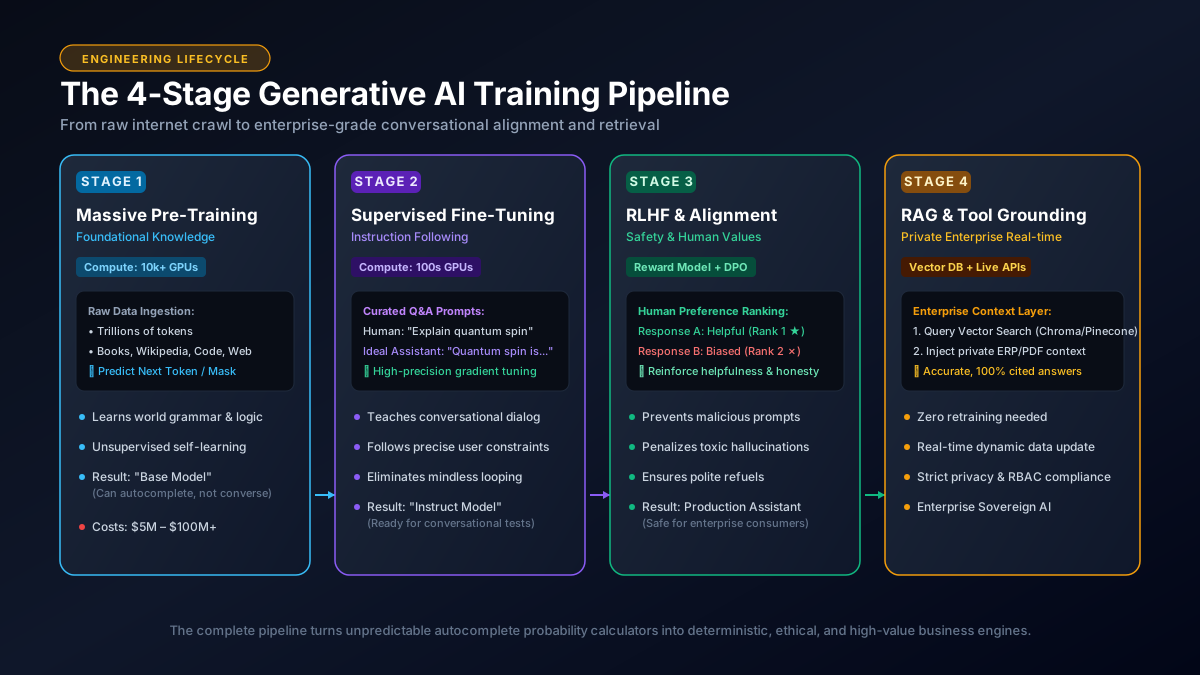
Here is the rigorous 4-stage lifecycle used by premier AI research laboratories to transform raw data into an intelligent, enterprise-ready co-pilot:

  1. Step 1: Stage 1: Massive Unsupervised Pre-Training (The Foundation)

    The neural network ingests trillions of words from books, academic papers, websites, and code repositories. In this phase, the model has only one goal: guess the next word in the sentence. Through billions of trial-and-error attempts, the model self-learns grammar, geography, history, mathematics, and programming logic. The output is a 'Base Model'—vastly knowledgeable, but clumsy at following conversational instructions.

  2. Step 2: Stage 2: Supervised Fine-Tuning (Instruction Tuning / SFT)

    In this phase, expert human annotators write hundreds of thousands of high-quality, curated question-and-answer pairs across complex disciplines. The base model is trained on these examples to learn the conversational contract: how to summarize documents, follow constraints, format answers in markdown, and respond with professional clarity.

  3. Step 3: Stage 3: Reinforcement Learning from Human Feedback (RLHF & Alignment)

    To ensure the model is safe, truthful, and helpful, human reviewers evaluate multiple alternative responses generated by the model, ranking them from best to worst. A secondary 'Reward Model' learns these human preferences and uses reinforcement learning algorithms (such as PPO or Direct Preference Optimization / DPO) to optimize the AI's behavior, penalizing toxic outputs and rewarding accurate, polite reasoning.

  4. Step 4: Stage 4: Enterprise Grounding & Retrieval-Augmented Generation (RAG)

    In production deployment, the static model is connected to real-time external knowledge bases, vector search databases, and company APIs. When a user asks a question, the system retrieves relevant private documents first and passes them as verified context into the prompt, eliminating hallucinations and ensuring zero data leakage.

Generative AI is not a database query engine; it is a general reasoning engine. It does not merely regurgitate what humanity has already written—it navigates the latent geometric space of concepts to synthesize novel solutions to problems we have never encountered.

— Dr. Fei-Fei Li, Co-Director of the Stanford Human-Centered AI Institute

Comparing Generative AI Architectures: Transformers, Diffusion, GANs & VAEs

Architecture Core MechanismPrimary ModalitiesKey StrengthsArchitectural Tradeoffs
Autoregressive TransformersMulti-Head Self-Attention calculating contextual token relationships Text, Source Code, Molecular Sequences, Symbolic ReasoningExceptional long-range context handling, emergent reasoning, versatile multi-taskingMemory consumption scales quadratically with context length; high inference compute costs
Diffusion Models (DDPM / Latent) Iterative reverse denoising of Gaussian random noise conditioned by textPhotorealistic Images, High-Definition Video, Spatial Audio, 3D MeshesUnmatched aesthetic fidelity, stable training dynamics, zero mode collapseSlower multi-step inference requiring 20 to 50 denoising iterations per sample
Generative Adversarial Networks (GANs)Zero-sum min-max game between a Generator and a DiscriminatorReal-time image upscaling, neural face filters, style transferBlazing-fast single-pass inference (sub-millisecond generation times) Notoriously unstable training dynamics, prone to mode collapse (repetitive outputs)
Variational Autoencoders (VAEs)Encodes inputs into a continuous probabilistic latent distribution and decodes Compressed latent representations, anomaly detection, synthetic tabular dataMathematically principled, smooth and interpretable latent vector interpolationTends to generate blurrier visual outputs compared to modern diffusion models

Real-World Industry Transformation: From Novelty to Enterprise ROI

In its initial commercial wave, Generative AI was often treated as an entertaining curiosity—a tool for creating funny limericks or generating fantasy avatar pictures.

Over the past twenty-four months, that perception has permanently evaporated. Forward-thinking enterprises, universities, and healthcare systems are deploying Generative AI as an indispensable productivity multiplier and operational substrate.

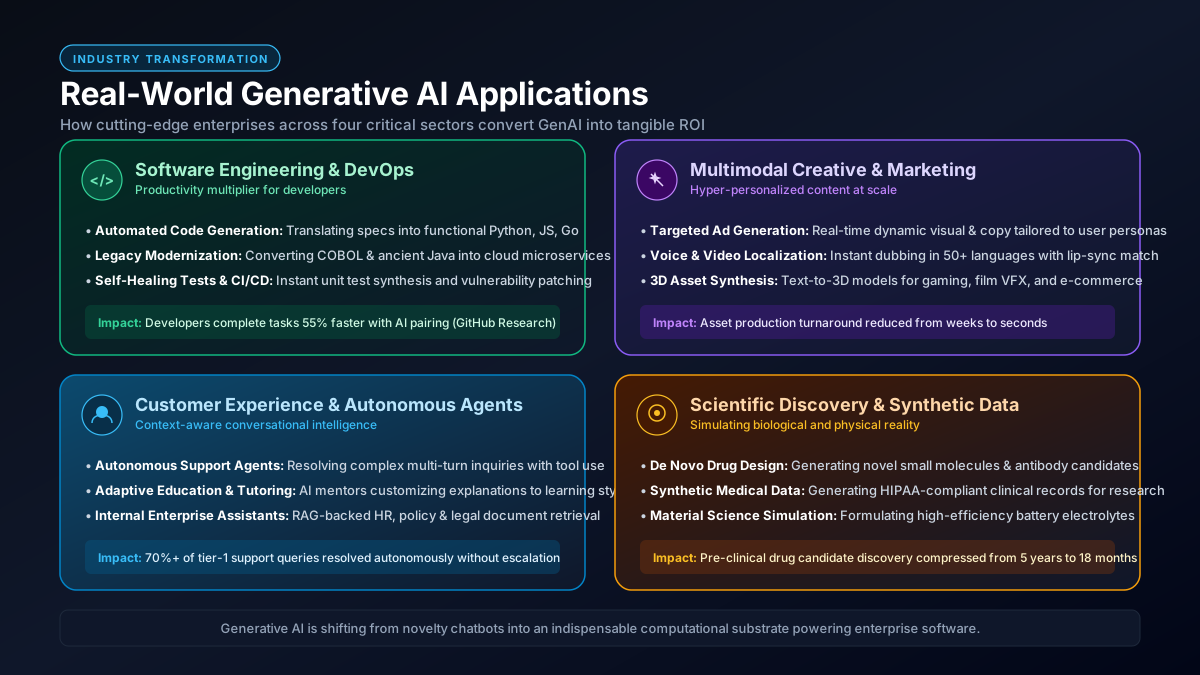
The economic and operational impact is unfolding across four critical industry vectors:

  • Software Engineering & DevOps: Modern developers paired with AI coding companions ship production features 55% faster according to GitHub research. AI assistants automate boilerplate code, translate legacy COBOL and Fortran architectures into cloud-native microservices, generate comprehensive test suites, and audit security pull requests.
  • Customer Experience & Autonomous Agentic Workflows: Legacy customer support bots that frustrated users with rigid decision trees have been replaced by empathetic, context-aware AI agents. These agents interpret complex customer queries, query backend ERP and CRM systems via secure tool use, issue refunds, and resolve over 70% of tier-1 support tickets without human intervention.
  • Life Sciences, Genomics & Accelerated Drug Discovery: Generative models are compressing the timeline for early-stage pharmaceutical research from five years down to eighteen months. Diffusion-based molecular models design de novo therapeutic antibodies, predict complex 3D protein folding dynamics, and generate synthetic patient cohorts that preserve medical privacy while enabling breakthrough clinical research.
  • Creative Media, Digital Marketing & Hyper-Personalization: Global marketing organizations generate thousands of localized, culturally tailored creative variations in minutes rather than weeks. Voice synthesis platforms enable instant multi-language video dubbing that preserves the speaker's original vocal timbre and synchronizes lip movement in real time.

Navigating the Frontier: Critical Challenges, Hallucinations, and Ethical Guardrails

As with every transformative technological leap in human history—from the printing press to the internet—Generative AI introduces profound challenges alongside its immense opportunities.

Building sustainable, responsible AI solutions requires confronting four critical engineering and governance realities:

  • The Hallucination Dilemma: Generative LLMs are mathematical probability engines designed to produce fluent, plausible-sounding text; they possess no innate concept of empirical objective truth. When asked about obscure or unverified topics, a model may fabricate citations, legal precedents, or medical claims with absolute confidence. Counteracting hallucinations requires architectural grounding through Retrieval-Augmented Generation (RAG), strict temperature control, and multi-agent cross-verification checks.
  • Data Provenance, Copyright, and Intellectual Property: Because foundation models are trained on vast corpora of public internet data, questions surrounding copyright infringement, fair use, and artist compensation remain fiercely debated in global courts. Enterprise leaders must adopt commercial models that provide indemnification warranties, adhere to transparent training data provenance, and respect content creator opt-outs.
  • Computational Energy Consumption & Sustainability: Training a frontier multi-trillion parameter model consumes gigawatt-hours of electricity and millions of gallons of cooling water. The industry is responding with radical efficiency innovations: Small Language Models (SLMs) like Microsoft Phi and Mistral that rival massive models at a fraction of the compute cost, 4-bit quantization, and energy-efficient neural processing units (NPUs).
  • Safety, Alignment, and Adversarial Vulnerabilities: Malicious actors continually probe generative models with adversarial prompt injections and jailbreaks aimed at bypassing safety guardrails to generate malware, phishing campaigns, or hate speech. Modern deployments require multi-layered defensive armor: automated red-teaming, input-output safety guardrails, and cryptographic watermarking for synthetic media.

Frequently Asked Questions About Generative AI

Does Generative AI truly 'understand' what it is saying or is it just sophisticated autocomplete?

Generative AI does not experience subjective consciousness or genuine biological understanding in the human sense. At a computational level, Large Language Models operate by predicting the most statistically probable next token conditioned on the prompt. However, calling modern models 'just autocomplete' minimizes what is happening mathematically. To predict the next word accurately across millions of diverse subjects, the neural network must construct an internal representation—a world model—of grammatical rules, physical dynamics, causal logic, and contextual nuance within its high-dimensional latent space. It possesses functional, semantic competence without subjective awareness.

What is the fundamental difference between a Foundation Model, an LLM, and Generative AI?

Think of these terms as concentric circles. Generative AI is the broad umbrella category encompassing any artificial intelligence system capable of creating new digital content (text, image, audio, 3D). A Foundation Model is a specific, massive neural network trained on broad, multimodal data at scale that can be adapted and fine-tuned for hundreds of downstream tasks. A Large Language Model (LLM) is a specific type of foundation model that specializes primarily in natural language processing and text generation (such as GPT-4, Claude, or LLaMA).

Why do Generative AI models hallucinate, and can hallucinations ever be completely eliminated?

Hallucinations occur because generative models are trained to optimize for fluency and statistical likelihood rather than factual verification. When the model encounters a gap in its training distribution, its probabilistic nature compels it to generate words that sound stylistically authentic, even if factually untrue. While hallucinations cannot be 100% eliminated inside the standalone weights of a black-box model, they can be virtually suppressed in real-world software architectures using Retrieval-Augmented Generation (RAG), where the model is strictly constrained to cite facts exclusively from verified enterprise documents.

Can small businesses or educational institutions build their own Generative AI applications without spending millions?

Absolutely! You do not need to train a multi-million-dollar foundation model from scratch. Thanks to open-weight models (like Meta's LLaMA 3, Mistral, and Google's Gemma) and affordable API endpoints, small businesses and colleges can build sophisticated, production-grade AI tools for pennies. By leveraging techniques like prompt engineering, vector databases with RAG, and Parameter-Efficient Fine-Tuning (PEFT/LoRA), an organization can create custom AI tutors, internal policy search engines, and automated administrative assistants with modest hardware and minimal budgets.

What is the difference between Fine-Tuning an AI model and using Retrieval-Augmented Generation (RAG)?

An intuitive analogy is preparing for an open-book final examination. Fine-Tuning is like spending two weeks studying and memorizing textbooks so the knowledge becomes permanently ingrained into your long-term memory. It changes the model's internal weights, teaching it specific stylistic tones, vocabularies, or domain task formats. RAG, on the other hand, is walking into the exam room with the textbook open in front of you. The model's weights remain unchanged, but the search system fetches the exact relevant page of company data and places it right in front of the model to read before answering. For dynamic, frequently updated enterprise facts, RAG is faster, cheaper, and far more accurate.

Will Generative AI replace software engineers, writers, and creative professionals?

History suggests that transformative automation tools rarely eliminate entire professions; rather, they reshape the nature of the work. Generative AI eliminates repetitive, low-value mechanical tasks—such as writing boilerplate code, drafting first-draft marketing outlines, or manually rotoscoping video frames. This elevates professionals into architects and directors who orchestrate, curate, verify, and guide AI systems. As the common industry adage states: 'AI will not replace humans, but humans who leverage AI will inevitably replace humans who refuse to.'

Conclusion: Embracing the Future of Human-AI Collaboration

Generative Artificial Intelligence is not merely another passing trend in the hype cycle of Silicon Valley; it represents a foundational shift in how human civilization creates, communicates, and solves problems.

By transforming natural language into the universal programming language of computing, Generative AI has democratized creativity and cognitive leverage. A solo entrepreneur can now prototype an enterprise software application over a weekend. A high school student in a rural town can learn calculus from an infinitely patient, personalized AI tutor. A research biochemist can simulate thousands of novel molecular designs before stepping into a physical laboratory.

The organizations and individuals who thrive in the coming decades will not be those who fear or ignore this technological wave, nor those who blindly surrender human critical thinking to algorithms. The winners will be those who master the art of Human-AI Synergy—harnessing the boundless generative power of neural networks while anchoring them in human empathy, ethical wisdom, strategic vision, and creative discernment.

The canvas of the generative future is blank. How will you choose to paint it?